Showing posts with label birdwatching. Show all posts

Wednesday, May 3, 2023

Quiet paddle

The scientific name of this bird, the Grey Pelican or the Spot-billed Pelican, is Pelecanus philippensis. This is because an early description of the Spot-billed Pelican was based on a specimen captured at Luzon in the Philippines in the 1760s. The name stuck on, despite evidence which showed that even though the species ranged from Iran through the Indian sub-continent on to Indonesia, these pelicans only bred in peninsular India, Sri Lanka and Cambodia.

The Grey Pelicans don't seem to be bothered by humans. They have large nesting sites close to human habitations and are quite content even inside cities. Chennai has a fairly large population; it is estimated that their population in southern India is increasing, to the extent that the IUCN has changed its Red-Book classification from "Vulnerable" to "Near Threatened".

Of course, with such a lovely environment as you can get at the Adyar Poonga, these birds are bound to be optimistic about their future. Unlike in the Philippines, where this bird, named for the islands, has been locally extinct since the 1960s!


Saturday, April 29, 2023

Yogi duck

The Indian Spot-billed Duck (Anas poecilorhyncha) is distinguished from its eastern cousin in a rather strange way. Despite being from a communist regime, the Chinese Spot-billed Duck (Anas zonorhyncha) does not have any red colouration on its bill. The Indian fellow, however, has a red path at the base of its bill which clearly distinguishes it from the other one. 

Until 2008 though, both these birds were considered as one species, the Spot-billed Duck. The 'spot' in those days referred to the yellow band which is visible in both species. In some ways it is rather surprising that it took so long for these two birds to be separated out: the powers-that-be of taxonomy are usually prone to changing nomenclature for a different shade of grey. Maybe they missed out the bright red daubed on some bills and not on others.

Or possibly they never saw Apoecilorhyncha do this earlier. Had the ICZN folks seen this duck standing like this, on one leg, they wouldn't have hesitated to add the 'Indian' to its name!


Wednesday, March 29, 2023

Treepie

From the family of crows and magpies, here is one that is endemic to India. The Rufous Tree-pie (Dendrocitta vagabunda) is a noisy bird, but one that is quick to make friends with humans. Like other members of the Crow family (Corvidae) it is extremely adaptable and an opportunistic feeder, which makes it difficult to dislodge.

Though it has a wide variety of calls, the ones we are most often subject to is the plaintive screech; thankfully it has other calls as well. But from this one, which visits our surroundings almost every day, does not deign to speak to us in anything other than its complaining tone!


Saturday, February 11, 2023

Red-eye

Across the sub-continent, this bird is feted in song and poetry. Thus, there was an ambience of mystery around it. Its loud call (of the male) is so strong and clear that it attracted the attention of the ancients; Aristotle has written about it, as have writers from Vedic times in India. Both of them knew about a specific behaviour of the Asian Koel - brood parasitism - which sits ill with the poetic celebration of these birds. 

This picture was taken in Chennai, for the bird is common pretty much all over the country. For all the hoary knowledge of the bird, and its frequent appearances in song and poems, often as a songbird, as a harbinger of spring, there is only one state of India that has chosen to have this as its state bird.

That is Puducherry; it is somehow entirely apt that this post is being written in Puducherry, where I am today!


Wednesday, January 25, 2023

Watching

A grey heron, seemingly lonely, at Sholinganallur. 

But don't get taken in by the loneliness. There is quite a lof of bird life at this place,  and I'm sure it will be packed with the participants of the Chennai Bird Race on Saturday. 

For now, let us just enjoy this picture from last year!


Sunday, January 22, 2017

Bird unseen

I have this old chestnut for the day of the Chennai Bird Race, when I go back to give in my log sheet to the volunteers manning the desks. I tell them that my team saw a few ostriches, and they start, because they haven't heard of the Post Graduate Research Institute in Animal Sciences at Kattupakkam, about 17 km from Tambaram. 

This year, I did not use that, mainly because my team did not see any of these ostriches. We did go to the PGRIAS, but we were intent on improving our bird count and so did not spend any time going over to watch the ostriches at their research area. Of course, the Bird Races do not accept any sighting of captive birds, so the ostriches were never going to add any heft to the count.

So, the picture here is from a few weeks ago. Without spending time on the ostriches, our team managed to top the 100-species mark for the first time this year!


Saturday, January 21, 2017

Eat like a bird

Tomorrow is the 10th edition of the Chennai Bird Race. About 50 teams, of 4 members each, have registered for the race. The idea is to spend the whole day, from 6am to 6pm, birding in and around Chennai - the boundaries are not very sharply defined, but broadly, it stretches from Pulicat in the north to Vedanthangal in the south. It is not necessary to cover the entire stretch; you can choose to stick to just a couple of spots within the city as well. The main thing is to spot as many of the 260-odd bird species of Chennai as you can.

The teams had to collect their log books today. The teams have to come in and sign up, pick up their log books, meet fellow birders and get into the excitement of tomorrow. What better place to do it than this restaurant - Spoonbill - on TTK Road.

It helps that the person who runs this is a member of the MNS - and she will also be participating in the bird race tomorrow!


Sunday, January 18, 2015

Umbrella

A few weeks ago at Pallikaranai, I was fooled into thinking that the Forest Department had erected an observation tower, only to find out that it was just a water tank. But this one did not have any such surprises. What looked like rest-stop, with this thatch roof and a bench, was just that. It is the only one on the banks of the Pallikaranai marsh. It must have been the Foresters who had this put up. 

I just hope that there will be a few more such. And that they do not turn it into a lakeside eating joint or something!


Saturday, January 3, 2015

Thirsty birds

At this apartment complex, the residents have decided it is too cold to use the pool. That is good news for these Blue Rock Pigeons (Columba livia). Nobody is going to disturb them as they line up to drink water from here!


Monday, December 8, 2014

High-rise sunrise

The marsh at Pallikaranai is somewhat better protected these days, at least on the southern side of the SH109. The fringes are greener than what they used to be. A small concrete cabin at the eastern end of the marsh indicates the presence of the forest department, even though I have never seen the cabin occupied. 

Haven't gone across to the southern bank of this marsh, though. Apparently there is a walkway into the marsh, as well as an observation tower there. Maybe if you climb up that tower, you can see the sun rise a few seconds earlier!


Friday, September 26, 2014

Wilderness

Yes, there are several out-of-the-way places within the city itself. One of them is the Nanmangalam Reserve Forest. We have seen parts of this forest before - it is the one where the Great Indian Eagle Owl can be found. 

Getting into the forest a couple of weeks ago, we noticed something different from our previous trips inside. There was far less plastic than we were used to seeing. Bowers near the road, which used to have several empty liquor bottles rolling around, were mostly empty and clear. Saplings of teak and other trees had been planted here and there. And then, on our way, we ran into another group, but they were being guided by an Anti-Poaching Watcher of the Forest Department. He demanded to know how we got in to the forest without permission, but wasn't rude about it. Got his boss to talk to us over his cellphone and made us commit to drop by at the Forest Office on our way out. 

Though we eventually did go to the Office and make all the required entries in their register, staying around inside the forest dulled our sense of time. So much so that the APW came back cycling to look for us, wondering if we were lost. In a way, we were; by that owl sighting, but also because there were some places like this that we couldn't tear ourselves away from!


Sunday, September 14, 2014

What a sighting!

The Nanmangalam Reserve Forest starts at the fork of the Tambaram-Velachery and the Medavakkam Main Roads and spreads over about 800 acres, with Greater Chennai surrounding it on all sides. It is the home of the Great Indian Horned Owl (Bubo bengalensis), also known as the Indian Eagle-Owl. Most of the forest is scrub jungle, but it also contains a few abandoned granite quarries within it. The quarry pits, with their rock faces, have enough crevices for birds to nest and several species do.

We missed the owl by a whisker at the first quarry we went to this morning. It heard us coming and away it flew, getting beyond eye-range even before our eyes could reach where it had been. We trudged around to the next quarry - a larger, deeper piece of work - but because it was slightly less accessible than the first one, we felt the owl would have a hideout there as well and we hoped it would get there sooner than later. 

We took our places at the edge of the quarry pit, looking down to the water that had collected in the pit, forming a nice little water body. And we looked across at the sheer rock face on the other side, trying to figure out where its nest could be. Then we heard the hoots. They seemed to be coming from the left and behind us: but with the quarry pit creating some echoes, we couldn't be sure. And then, I turned left and saw the big bird, gliding towards us. Dumbstruck as I made eye contact, I was sure it would either attack us, or swoop away, for there was no way it couldn't have seen us. But, it hadn't. Banking gently, it landed on the rock just below where I was sitting! For a few seconds, none of us moved. And then, I gently sent my arm out, camera at the end to take a picture. Managed to get a couple, before the bird looked around. This time, recognition followed eye-contact. Away it went, to the other side of the quarry, where it sat for quite a while, hidden by some foliage. You can see a picture taken by my friend, but the photo here is probably the only one I will get of a bird from above and behind it!


Saturday, April 19, 2014

Two of a kind

When a person starts birding, many long believed 'truths' turn out to be not so true. One of them is about owls. Most of us think of them as night birds; they may be mostly nocturnal, but there are many of them who are quite active during the day. Though first-timers might find it unbelievable, it is quite common to see owls during the daytime, even in the middle of the city. 

One of the common species of owl is the Spotted Owlet (Athene brama). It is a small bird, and is unfazed by the presence of humans nearby. You can spot them on the IIT Madras campus, on the golf course at the Cosmopolitan Club and several other places that are overrun with people. The two of them in this picture - can you spot them? - are at the TANUVAS' Research Station at Kattupakkam, on the outskirts of Chennai.

Athene brama usually nests in holes - that should be enough of a clue for you to click through the picture and spot the Owlets!


Tuesday, March 18, 2014

Beyond the backwaters

Early morning at one of the southern backwaters of Chennai. The Kelambakkam marsh and salt pans are home to a variety of birds. We were probably not early enough to see most of them, but we did manage to get a list that included kingfishers, storks, cormorants, herons and egrets, as well as a few of those little brown jobs that are the very devil to identify. 

And no, I can't identify those buildings in the distance definitively either, but I believe they are the apartments of the Hiranandani complex. Now, don't ask me which one!


Thursday, March 6, 2014

Birdspotting

Even in the middle of the city, there are some places that continue to remain rather rustic. Coconut palms - probably planted at a time when folks still believed in a house-and-ground rather than an apartment and UDS - are quite common. And if there are other trees nearby, it is not too difficult an environment for fauna, especially birds, to get by. 

And that's how this Lesser Flameback landed up on the trunk of the palm. He had been visiting this spot off and on, never staying for more than a minute or so before flying off. On this day, he decided to stick around a little longer and examine the suitability of the palm as a residence. Managed to get a couple of long-distance pictures before he moved over to the other side.

Can you spot him? Come on, it shouldn't be too difficult!

Update, March 13: It has been pointed out that there are more than one of the Flameback in this photo. Of course. That's the reason why they spent more time on that day - which was about 4 years ago, and that's my excuse for a poor memory!


Wednesday, February 5, 2014

Bird tree

There are some trees that attract birds; the ficus are the ones that come to mind first. The neem (Azadirachta indica), with its bitter bark, leaves and fruits is not the one which you would expect to find a whole lot of birds flocking to.

But when the branches are just overhead and one can hang up the birds to be at eye-level, the neem certainly attracts birds of a completely different feather!


Tuesday, February 12, 2013

Thirsty birds

It is just February and Chennai is getting into its second season - the 'Hotter' season. Temperatures are in the high 20s and are expected to move into the 30s during this week (and that's Celsius, in case you're wondering). Not dog days, yet, but bird days, maybe?

At the Ambattur Industrial Estate, there is certainly one bird lover, at least. Outside a factory gate, there is this mid-sized ficus growing. As in many other places, a shrine has come up under the ficus, showing all signs of being well tended to. On a more practical note, however, is the provisioning of water; there is a mud-pot in the shade, which I guess is for humans. The bird lover has gone further and set up this drinking trough, with some space for grains as well. We didn't get to see any bird use it - maybe they have to learn Tamizh, for it clearly says on the trough that it is "பறவைகள் தண்ணீà®°் குடிக்க (for birds to drink)"!


Sunday, February 3, 2013

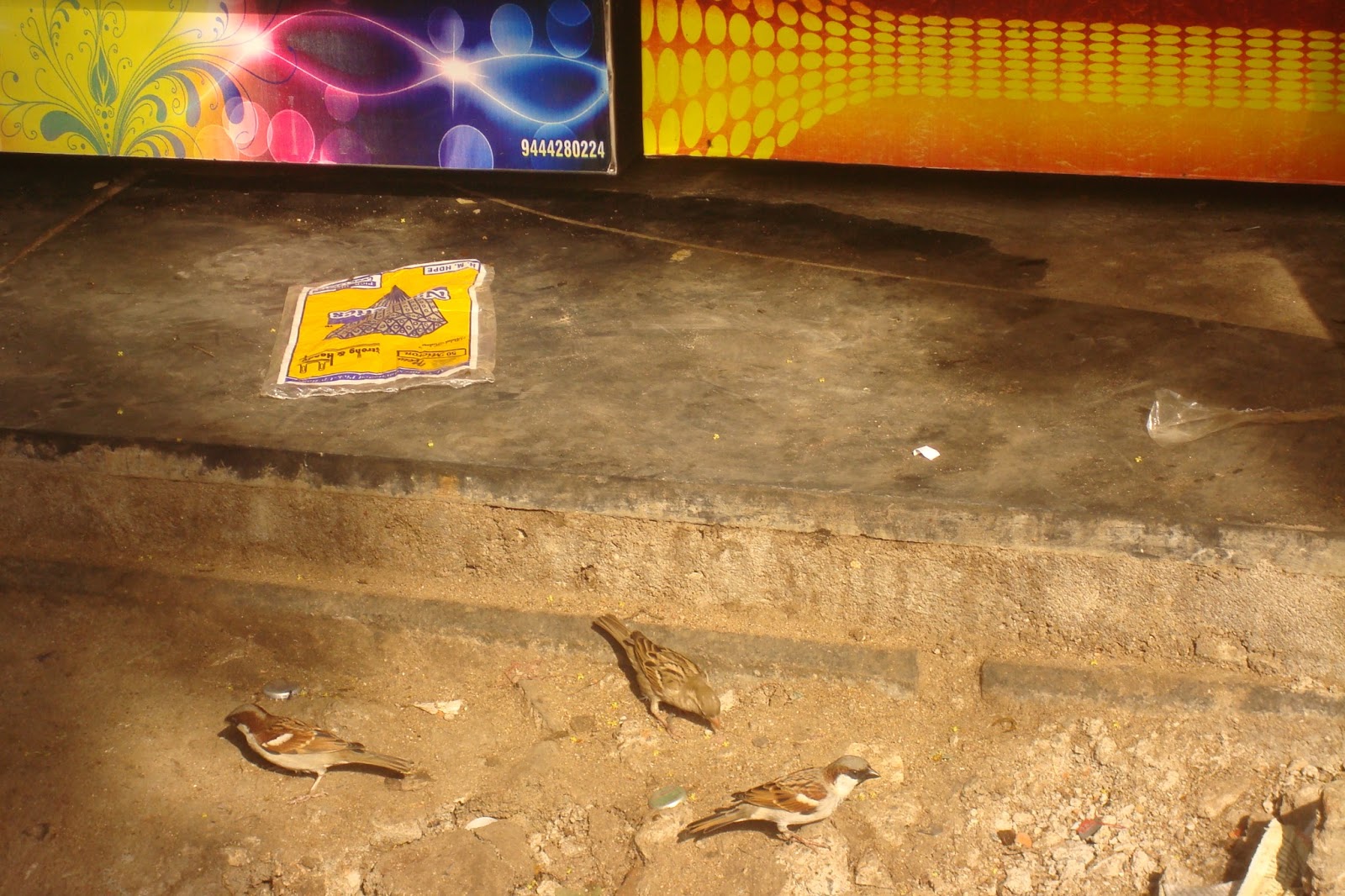
Sparrow family

The IUCN's Red List continues to list them as 'least concern', because of their large range and, within that range, their numbers seem to be large enough to be not worried about. If Chennai had a Red List, however, these birds (Passer domesticus) would be heading that list. A generation ago, you were in danger of these birds building a nest in your hair if you stood still for long enough. Today, their nests are not to be seen at all. 

First noticed this family at Santhome, just across the road from the AIR station, a few months ago. There were about eight of them, and they weren't too worried about people around them. And then I saw them again yesterday. Didn't watch them for long, but I got the feeling that they were all there. Maybe we've taken them for granted too often for too long; I'm sure you don't believe me when I say they are almost non-existent in Chennai. But think about it, when did you last see one?

If you would like to do something about helping these birds, you can start off with getting them a nest box. You can find the link on this site - and do let us know when the sparrows start using them!


Sunday, December 30, 2012

Chasing birds

It was the sixth edition of the annual Chennai Bird Race today; there is no way I would be able to take a halfway decent bird picture with my dinky camera, so you'll have to be satisfied with this one - you can see the entrance near the top. It is the abandoned nest of a subird.

This was taken at the Nanmangalam forest. We did see about 35 bird species there, but not the poster boy of the place, the Great Indian Horned Owl. Disappointed!


Monday, December 10, 2012

Highway traffic

Tamil Nadu has about 61,500km of roads running across the state. Of them, roughly 9,200km are designated as state highways. There are not many that were conceptualized as highways and constructed accordingly; most of them are roads that were in existence and were given the title because of their importance. 

State Highway 109 was not one of those. There are stretches where SH109 has taken over existing paths, but more than half of it was specifically laid to connect the suburb of Pallikaranai with Thoraipakkam. In doing so, it cuts through the Pallikaranai Marsh, which has now been designated a reserve forest. 

Getting on to this stretch of SH109 early in the day, one is bound to spot many of Chennai's bird watchers. On both sides of the road, there are literally thousands of birds to be seen and that brings both amateur and professional ornithologists in sizeable flocks. But this place also attracts folks with a different passion: a fairly smooth and straight road, with minimal traffic, is the ideal stretch for the power vehicles to vroom away. In a 20 minute span, we saw a couple of Audis, a Porsche and a Harley open up their valves and fly away!