Showing posts with label Chennai Central. Show all posts

Sunday, April 23, 2023

Crowdless corner

Continuing on yesterday's theme, here is a picture of another public space that one would expect to be packed. 

Surprisingly, the foyer of the Chennai Central's has moments of emptiness!


Tuesday, April 4, 2023

Colour and tricolour

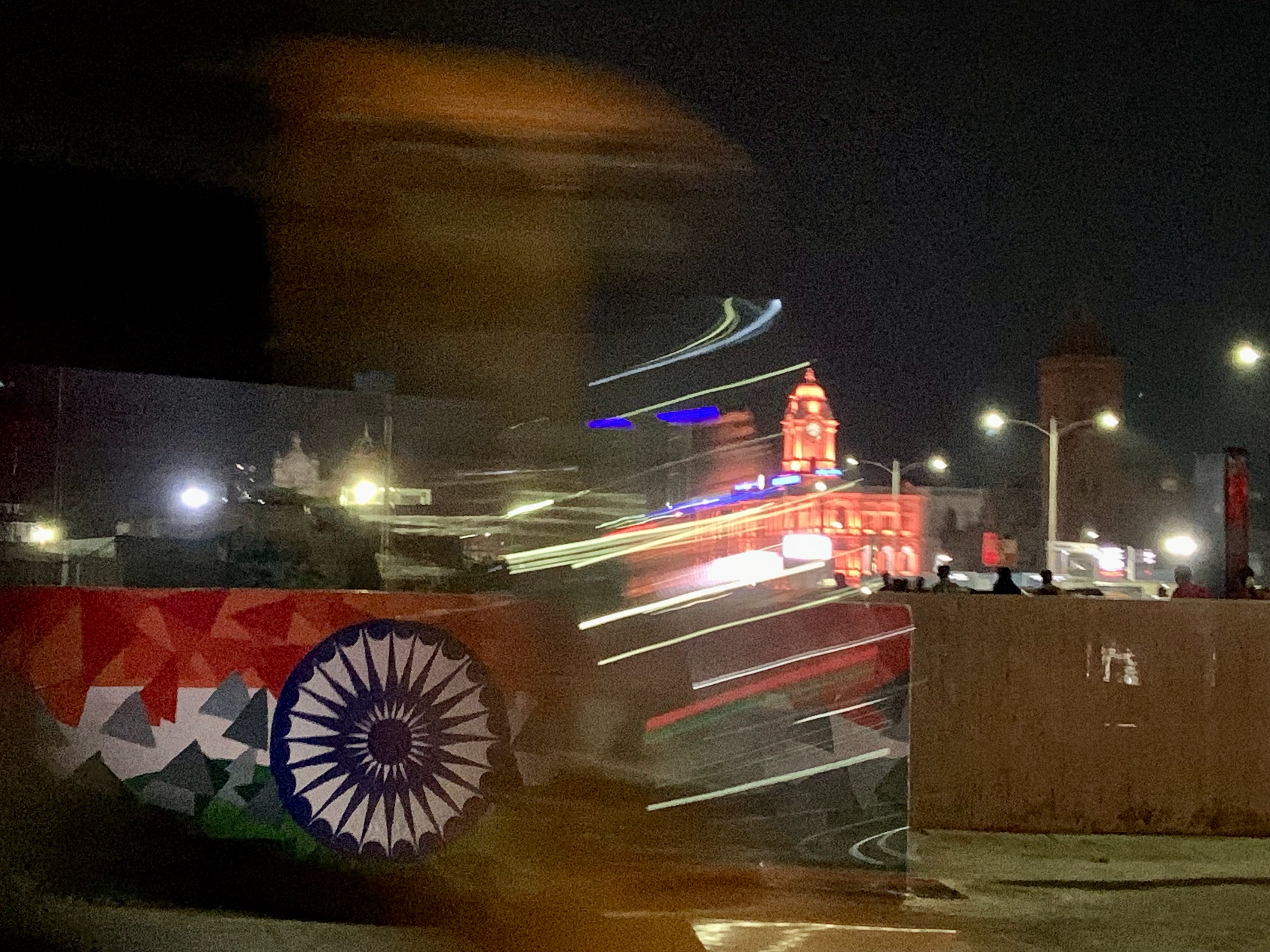
On my way to the Chennai Central station to take a train out tonight. Got rather excited at seeing the Ripon Building all lit up, but this is all I could get of it on my phone.

Maybe the colours were to mark Mahavir Jayanti, though I would have assumed white to have been the colour of choice in that case. The Ripon Building was fitted out with a 'dynamic lighting' system in June last year. A little over 200 light-units have been placed around the building, each of which could take on various combinations of the primary colours red, green and blue. Had thought of checking out the building on Independence Day last year, but missed that and also this year's Republic Day, both of which would have seen the building decked out in the tricolour. 

Sheer coincidence then, that my scramble to click a picture also got a tricolour painted on the wall of the bridge. I have no idea how I managed to get all of these in one shot!


Wednesday, March 1, 2023

Noiseless

They say it is an experiment, but we know how that is going to go. On Sunday, the voice of Kavitha Murugesan, piped through the public address system for the last time at the Chennai Central. I did not realise it at the time I was making the post two days ago, but quietness is now a theme at this station. It is the first time in the country that a railway station has stopped announcements about the arrivals and departures of trains. 

With most people already figuring out the information about platforms, arrival and departure times through apps on their phones, the voiceover information had become irrelevant over the years. Chennai has just got ahead of all the other railway stations in doing away with that relevance. Maybe the General Manager of the Southern Railway decided that this station should behave more like an airport. 

And so Kavitha Murugesan, the lecturer / dubbing artiste from Erode, whose voice was the one guiding travellers to their platforms, matching them with the trains they are meant to take, will no longer be heard here!


Update: On March 4, the Railways decided that they need to bring Kavitha back. The lack of announcements was causing a problem, mainly to those visually impaired, so they've been brought back. Chennai Central continues to make noise!

Monday, February 27, 2023

Quiet place

I doubt if that is the phrase you would use to describe the vicinity of the Chennai Central railway station. With more than a plentitude of letters in its official name: Puratchi Thalaivar Dr Dr. M.G. Ramachandran Central Railway Station, it only follows that even the vicinity would be crowded with people and vehicles jostling to get into or away from a major gateway to the city. 

This must have been a synchroised lull in the arrival and departure of all forms of transport. No editing has been done on this picture, it is the way the scene was. For a few seconds, at least, the spot around Chennai Central was as peaceful as a desert island!


Sunday, February 26, 2023

Across the road

This is not a spot from which one can usually take pictures. The Victoria Public Hall is under renovation (that's one thing that does not seem to change over the years) and there are restrictions on public entry into that building. We had managed to get permission to go in and walk along demarcated areas; one such was the verandah on the first floor. 

It is nice to see the lawns outside and think of the possibilities of how this can be a great public performance venue once the renovation is complete. 

Are you able to identify the building across the road n this picture? If you have guessed it to be Siddique Sarai, you are absolutely correct!


Wednesday, February 22, 2023

Travel pangs

It is not just armies, but travellers too, who march on their stomachs. There was a time when the choices of food when taking a train out of Chennai Central would be: a) goop from vendor A or b) goop from vendor B. 

I believe goop has disappeared now. And the options have increased. Adyar Ananda Bhavan will itself give you a decent choice of food, and with the biriyani joint above it, one would not want for choice of non-vegetarian fare, either. 

What's your favourite food on a train journey? 


Wednesday, January 18, 2023

Coincidence?

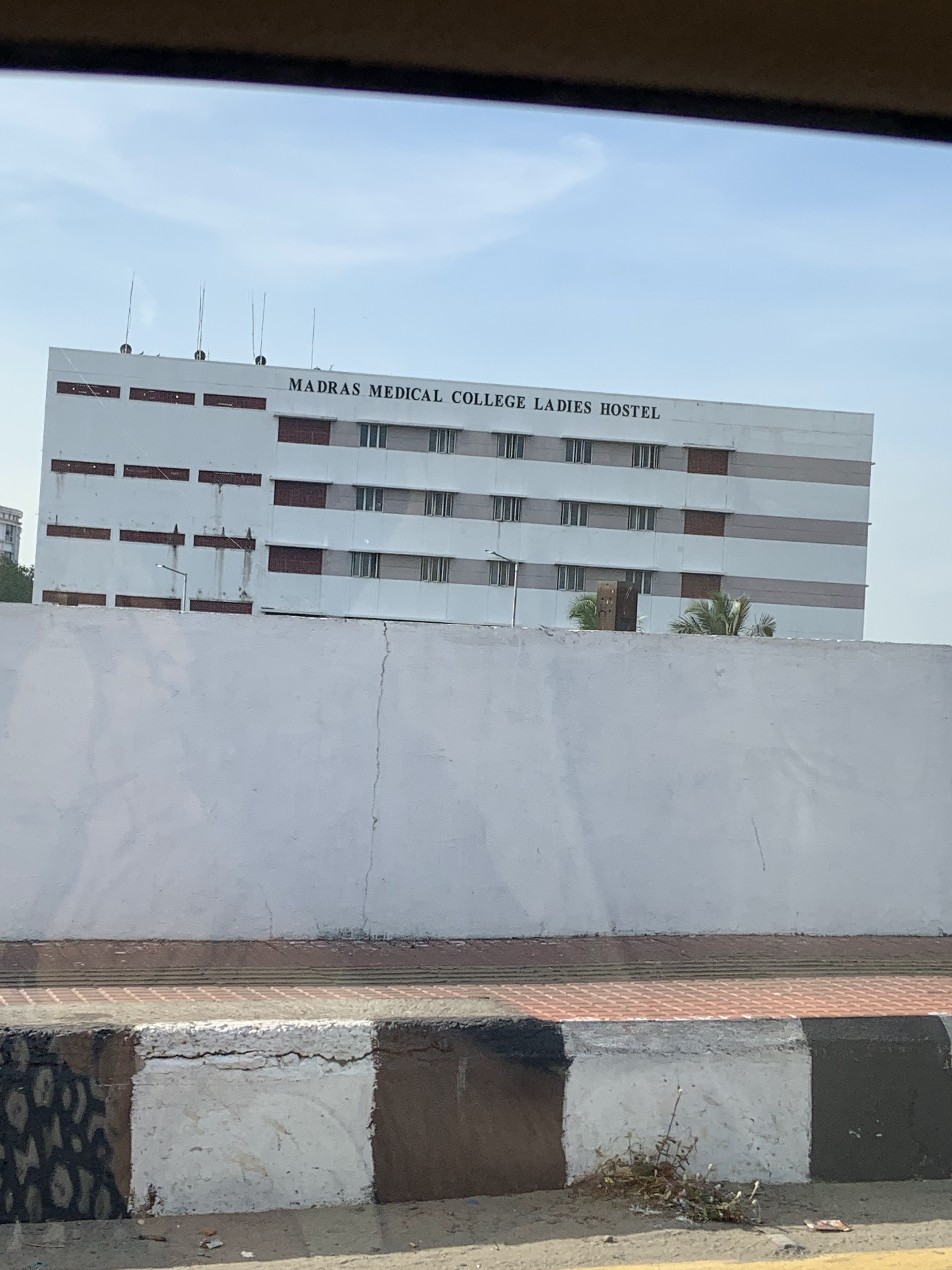
Passing by this building a couple of days ago, I was struck by something that I'm sure is entirely coincidental. You see, this building, which is the new Ladies Hostel of the Madras Medical College stands on the spot where the Chennai Central Prison used to be. 

This prison was the new jail; though it was established in 1837, it continued to be the 'new jail' until the Puzhal prison came up in the late 1990s. That was because there was an older Debtors' Prison, which was a little further to the north, in the Mint area. That stopped functioning in the 1830s, and since then, those buildings have been put to other uses.

And what did that end up being? Well, the Old Jail Road runs from the Mint Street Clock Tower to the Bharathi Women's College. As I had said, it is entirely coincidental that the spot which supports women's education was once a jail, much like this one here. Entirely coincidental!


Sunday, January 1, 2023

Newness!

Have you been to Chennai recently? If you haven't, then you may not know about the changes around the Chennai Central Station. The Central Square of Chennai, which is supposed to come up around the station, has started showing signs of progress. Some buildings near the station - Victoria Public Hall and Ripon Building - have had space in front of them cleared and you can get a far better sense of the grandeur of these buildings than you could earlier. 

There is still a lot of work going on around the place. The Chennai Metro still has a lot of digging and shaping to do. There is talk of a massive underground car park. The Central Square of Chennai, when it is complete, would have other buildings (the Southern Railway Headquarters, the Moore Market Complex, the Rajiv Gandhi Government General Hospital and of course, the Chennai Central Station itself) contained in its 8-acre spread. There will be other heritage buildings - or, as in the case of the Ramaswamy Mudeliar Choultry, just a vestige marking the spot - around this square. 

It would take a few years to be complete, but I hope all of this will not only provide open space for the people to chill (there are quite a few doing so these days anyway) but will also bring back the Victoria Public Hall as a performance space. From the outside, it looks much better than I remember it anytime over the past 15 years; but the inside is still very crumbly. One looks forward to taking in a show, or a lecture, at this hall before... well, 2028? 


Sunday, July 27, 2014

Big man

We have seen this man before. Here. He sits in the middle of the Peoples' Park, lording it over the grounds. This is the statue of Diwan Bahadur R. Subbayya Naidu, CIE who was Commissioner of the Corporation of Madras between 1937-40. 

Though there is not much that I have been able to find about his tenure. He seems to have been a civil servant dedicated to the Empire rather than to the people. An announcement in the Straits Times of Singapore on January 21, 1937, informs us that Subbayya Naidu was a former Agent of the Government of India in British Malaya - he certainly did get around. 

Until 2008, this statue, like the others in the park was all uniformly white. Whoever came up with this colour scheme probably thought of this man as a blue-blooded sahib!


Wednesday, July 16, 2014

Look again

No,  this is not a timeline or a wall. It is just a part of the social media spilling out on to the roads. Sydenhams Road, to be specific. 

Can any social media outfit match the range of merchandise offered by this shop?


Friday, July 11, 2014

Market model

In the evening of May 30, 1985, the city of Madras heard about a fire near the Central Station. By the next morning, the fire, supposedly set off by an electrical fault, had completely gutted an 85-year old icon of the city. More than 20 fire engines, including Simon Snorkel, had battled the blaze, but the combination of paper, cloth, vinyl and plastic made sure that the building was beyond salvage. Thus ended Moore Market, the go-to place for old books, records, clothes, pet supplies, exotic meats and pretty much everything that anyone in Madras might have a fancy for. 

In the closing years of the 19th century, an organized market for groceries, meats and other items was a dire need for the city's European (and westernized) residents. An earlier market, on Popham's Broadway, had been long marked down as being unsanitary, but no concrete action on an alternate had been taken. Enter Sir George Montgomerie John Moore, who had taken over as President of the Corporation of Madras in 1886. Though he had begun addressing this requirement in the early days of his term, the selection of a suitable site - which turned out to be a corner of the Peoples' Park near the Central Station - and clearing it up (there was a thriving Gujili Bajaar (okay, Guzili Bazaar), a grey market of second-hand, counterfeit and purloined goods operating there) took a while and it was only in 1898 that the foundation stone was laid.

Sir George was clear that apart from its functional requirements, the new market should aesthetically blend its architecture with its neighbours, Central Station to the east and Victoria Public Hall to the west. The architect chosen was R.E.Ellis and the market was built by A. Subramania Iyer. In 1890, the Governor of Madras, Sir Arthur Havelock opened the Moore Market for trade. Over the course of the 20th century, the Moore Market served the needs of a variety of Madras' citizenry, until other shopping options came up in the 1970s and 80s. Yet, Moore Market held on. The bookshops were a bibliophile's paradise and many other things beside. With that fire on a summer night, a part of Madras' soul was extinguished. 

There are many claimants to the name today. The Allikulam (அல்லி குளம் - Lily Pond) complex tries to pass off as today's Moore Market. There is a digital version somewhere. The Railways call their office complex (built where the market stood) the "Moore Market Complex (MMC)". But the original building can be seen in this faithful replica, right in the middle of the parking complex outside the Railways' MMC. The model is quite exquisite, but the way it is neglected forces one to thinking that it might meet the same fate as its original!


Sunday, December 23, 2012

What crowd?

If I told you this photo was taken almost directly opposite Chennai Central station, you would probably call me crazy. It is one of the quietest spots you can find on that stretch of Poonamallee High Road; chances are, however, that you've rushed past this building without thinking of what lies inside.

The Ramasamy Mudeliar Choultry has a pretty big yard, once you get inside the gate. It was also the place where the Hop-On-Hop-Off buses used to start from (wonder where they are, now?). And inside is the (probably) only statue of the man who gave a lot to the city where he made his fortune.

Go inside, see it for yourself. And be happy that even in the middle of all the rush, Chennai still has oases of Silence and slow Time!


Monday, May 23, 2011

The Rajah at the choultry

Were he alive today, he'd be getting on to his 170th birthday, which is what the Wikipedia entry on him seems to indicate. Rajah Sir Savalai Ramaswamy Mudaliar, KT CIE has been away from us for over a century, but during his time he was a big enough philanthropist for his name to be seen in several places over Chennai. People miss it because it is in a narrow band on the choultry. They miss it because the initials "R.S.R.M." in Government RSRM Lying-In Hospital in Royapuram means nothing to them. His place of burial in Kilpauk, where he once owned a vast stretch of land, is probably inaccessible now.

This statue, erected by his friends, is probably the only one in the city. The man who was given the title Rajah as a personal distinction - rather than as a hereditary keepsake - keeps a watch over one of his favourite gifts to the city from right inside it!


Wednesday, March 10, 2010

Break journey

Looking at the time this picture was taken - 0833 hrs - I assumed that the Chennai Central was experiencing that slight lull when the first rush of the morning's work has given way to thought about that cup of coffee.

However, there is no real break worth its name for more than 15 minutes at Chennai Central; trains are either coming or going at all hours of the day, except between 2345 when the last trains for the day leave (the Ahilyanagari Express, Raptisagar Express and the Korba-Thiruvananthapuram Express) and 0215 when the first trains (Chandigarh-Chennai Express and Dehra Dun - Chennai Express) arrive.

The lack of crowds at this time was probably a freak phenomenon; like one of those ghost traffic-jams, a ghost break-in-the-journey!


Thursday, January 28, 2010

Another rest-house

Its appearance is not as imposing as that of the choultry or the sarai which lie to the south of the Chennai Central railway station. Given its location on the eastern side of the station, on Wall Tax Road, it probably served a customer segment less fussy than the ones frequenting its southern neighbours.

It is not much younger than them, though. The choultry was in all likelihood a late 19th century construction, while the sarai came up in the 1920s. This dharmasala is probably a contemporary of the sarai. The similarity to the sarai continues in that the sponsors of this dharmasala were traders - Paramananda Doss and Chotta Doss, who set up their eponymous firm in 1888, trading in cloth from Benares.

Beyond that, there's little that I've been able to find out about the twin Doss-es. Surely their firm continues to survive somewhere in the warren of George Town!

Saturday, January 2, 2010

A word a day

When India became a republic in 1950, the Constitution of India did not mention anything about a national language. It was an issue that had many of the members of the Constituent Assembly take strong positions; ultimately the Munshi-Ayyangar formula paved the way for Hindi to be declared as the 'Official Language' with English as an associate Official Language for a period of fifteen years. The idea was to use that period to help all non-Hindi speakers learn the language and acquire some degree of expertise with it. The first Official Languages Commission's report recommended a step-by-step to eventually replace English and establish Hindi as the only Official Language, if not as the 'National Language'. However, violent reactions against the report led to Jawaharlal Nehru declaring that English could continue as the associate, additional Official Language for as long as the non-Hindi speaking people wanted it.

In 1963, the Official Languages Act was passed. Under that act, and its subsequent amendments, India continues to have both Hindi and English as the Official Languages of the Union - and any of the 21 other languages listed in the Eighth Schedule of the Constitution can also be used to transact the business of the Union. In offices of the central government and almost all central public-sector units, it is Hindi which is being taught in various ways to those who are non-native speakers of the language. One such measure is the 'Word-a-Day'; it has been around for nearly 20 years now. The day's Hindi word is displayed at several places within the office and is expected to be used in conversation during the day.

And what's the word I chanced to see a few weeks ago? One that has been the casualty in disagreements about the national / official language!


Saturday, October 24, 2009

Waiting for the train

Inside Chennai Central. As the passengers wait for their rake to come in, the 'licenced porter' uses the break to take a quick nap in the aisle. Everyone will burst into action the moment a coach is sighted in the distance!


Sunday, September 13, 2009

Don't read this...

Is this sign meant to reassure the good travellers that an omnipotent power watches over their well-being or is it meant to strike terror into the hard heart of one who has crossed over to the dark side? I think it is the former, but a spin-off is that a criminal reading this will think twice before attempting any funny business at this spot!

Of course you can't spot the cameras - they are secret, you understand?!


Monday, September 7, 2009

To treat them all

It is hard to believe that a major reason for relocating the military hospital of Fort St George to this site in 1772 was because it had, all around it, open spaces and was therefore considered to be much healthier than its previous location in (today's) Armenian Street. The decision to move was made in 1762, but it took another decade to be operationalized. John Sullivan, a young 'writer' won the tender for constructing the hospital buildings with a quote of 42,000 pagodas, which was almost 10% less than Col. Patrick Ross' outlay of 46,500 pagodas. It appears that the original specification of 1762, to build a hospital capable of receiving and accommodating "500 men and 30 officers" remained unchanged; the construction, though was reportedly designed so as to carry a second storey, when required.

The expansion does not seem to have been required until 1859. By then, the hospital had become truly 'general', with native civilians being admitted for treatment since 1842. (The military handed it over to pure civilian control in 1899). More additions were made through the last quarter of the 19th century; and then, between 1928 and 1938, a complete remodelling and much re-construction was done. With so much of chopping and changing, it is likely that none of the original buildings were still around when the most recent re-construction was done in 2002. That effort tore down all the hospital buildings and replaced them with these twin blocks - glass and concrete, but with the porticos shaped like those of Chola palaces.

While the open spaces around it have long since disappeared, the Government General Hospital's location is still convenient for travellers coming in - in these days of A(H1N1) threat, it may be reassuring to find this, the first hospital of India, waiting at the gates of the Chennai Central!


Thursday, August 27, 2009

Watch out

Of the major cities in India, Kolkata has an enviable crime rate (that's the number of crimes registered under the Indian Penal Code per thousand population) of 82.5, which makes it the lowest among major cities in India. Chennai's record on this is not as enviable; in 2007, the latest year for which data are available on the NCRB website, Chennai's crime rate was 256.9, far higher than even New Delhi or Mumbai. That it is much better than Bangalore (475.6) or Hyderabad (314.3) is scant consolation to a city which prides itself on its police force, one of the oldest in the country.

Of course there are always many reasons touted; Mumbai, New Delhi and even Kolkata have urban populations that are more than double that of Chennai, the Chennai police is more scrupulous about registering cases and the clincher being that the Chennai police has a better record of solving crimes than their counterparts elsewhere. Of the last, I have not been able to find data, though. Like any large city anywhere in the world, Chennai has a part of its populace leading a life of crime and like in any other large city, they find a good chunk of their victims among newcomers to the city. Overawed by getting to the city, their trust is easily obtained or attention easily diverted, which allows the petty criminal to run his trade rather smoothly.

Surely those newcomers would be better off if they could recognize such practitioners from these photographs - but this board at Chennai Central seems to be better hidden than a newcomer's valuables!