Showing posts with label medicine. Show all posts

Sunday, February 12, 2023

Multi-medicine

There is a ministry in the Central Government of India named the Ministry of Ayush. Of the 5 letters in that name, two were not very well known systems of 'alternatlive medicine' in the India of the 1940s. Yoga was esoteric, and homeopathy was a highly niche practice. So, when Vaidya Ratna Captain G.Srinivasamurthy, Professor Dr.C.Dwarakanath, Dr.Y.Suryanarayana Rao, Ayurvedacharya and D.M.Visweswara Sastry got together to set up a common pharmacy store for the country's traditional systems of medicine, they restricted it to Ayurveda, Unani and Siddha. 

The idea was to have a centralised facility to manufacture the lehyams, churnams, bhasmams and kashayams required by these systems. Between 1944 (when it was started functioning, on September 12) and today, the IMPCOPS (Indian Medical Practitioners’ Co-operative Pharmacy and Stores Ltd.) has grown almost 50-fold in membership to the 17,000 Registered Medical Practitioners on its books today. Back then, when IMPCOPS set up its manufacturing facility in Adayar, it was away from the main city, in sylvan surroundings. And it continues to stay that way; a long stretch on the LB Road where there was nothing but the IMPCOPS gate set in the wall. 

That was a rather inconspicuous gate until a few years ago. Under its current President Dr. Kannan, the IMPCOPS decided to get a facelift done, starting with its gate. These days, as you drive down LB Road, you cannot miss this structure. And besides this place, there is a factory in Tadepalle in Andhra, and hospitals in multiple locations across Tamil Nadu and Andhra Pradesh. So the next time you want some 'Indian' medicine, maybe this is the place you should look to!


Wednesday, January 18, 2023

Coincidence?

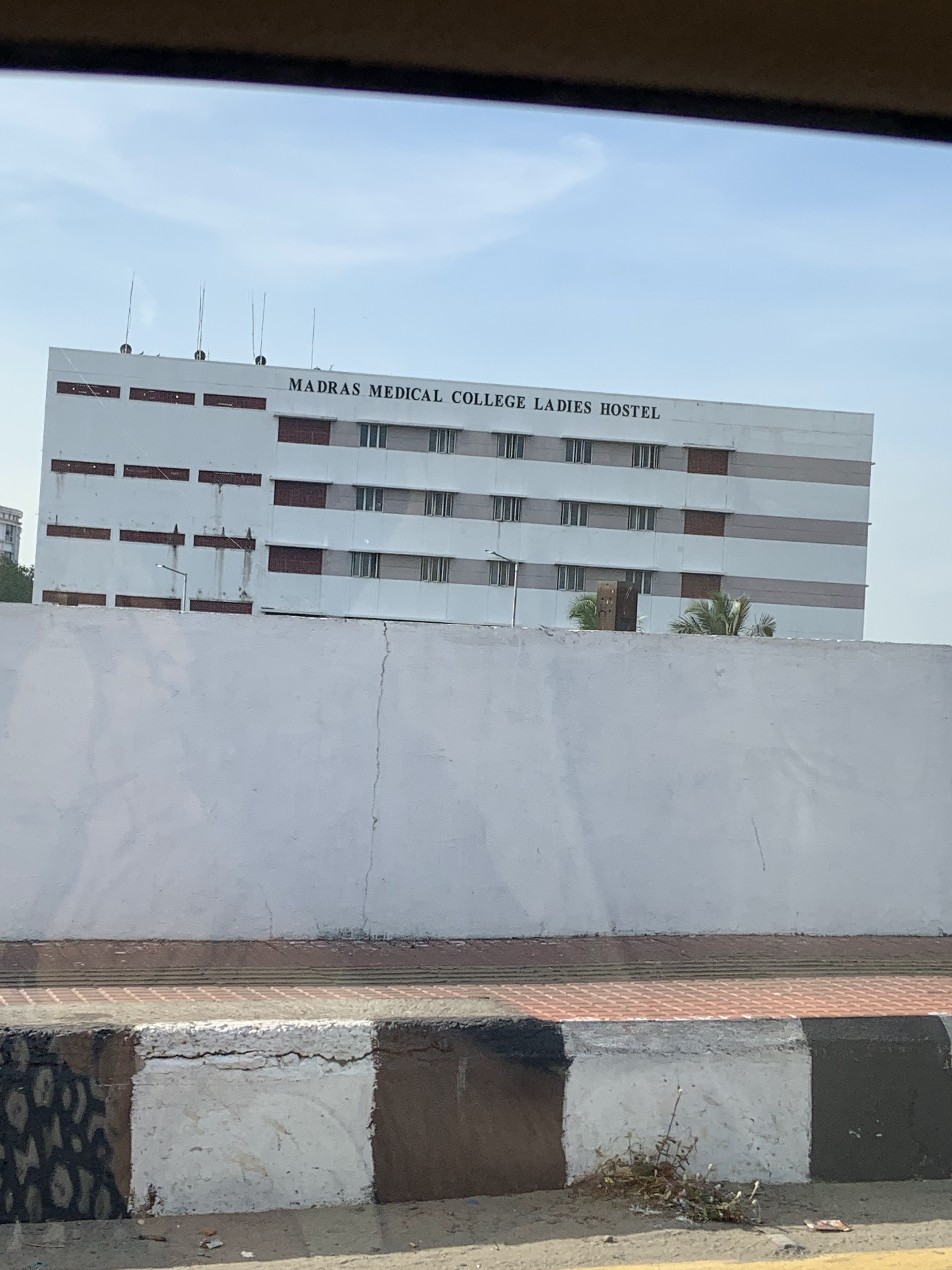
Passing by this building a couple of days ago, I was struck by something that I'm sure is entirely coincidental. You see, this building, which is the new Ladies Hostel of the Madras Medical College stands on the spot where the Chennai Central Prison used to be. 

This prison was the new jail; though it was established in 1837, it continued to be the 'new jail' until the Puzhal prison came up in the late 1990s. That was because there was an older Debtors' Prison, which was a little further to the north, in the Mint area. That stopped functioning in the 1830s, and since then, those buildings have been put to other uses.

And what did that end up being? Well, the Old Jail Road runs from the Mint Street Clock Tower to the Bharathi Women's College. As I had said, it is entirely coincidental that the spot which supports women's education was once a jail, much like this one here. Entirely coincidental!


Thursday, August 6, 2015

Granny told mother...

The stuff was concocted by William Woodward, a pharmacist in England, sometime in the 1850s. For some reason, the mix of sodium bicarbonate, dill oil, sugar water and a bit of alcohol became a runaway hit with the babies and by 1876 it was so popular that Bill decided to register "Woodward's Gripe Water" as a trademark. His advertising at that time was based on the message that "Granny told mother and mother told me" - a theme that will be familiar to Indians from the TVC that was popular in the 1980s

In India, the brand is licensed by TTK & Company, which is headquartered in Chennai. I was sure this one had gone the way of many other old brands - does any baby even want gripe water any more, when all she has to do is to focus on her mother's iPhone? - when I saw this in a store. Somehow, the solitary bottle of gripe water only served to reinforce the point that the market for gripe water has evaporated. 

Can't help feeling that once this one goes off the shelf, the brand will be done for!


Friday, January 9, 2015

Road to gate

James Lawder came to India as an Assistant Surgeon with the Madras Medical Service in July 1822. By then, he had been in service for a while and had seen action in the Peninsular War. He had also completed a stint in the USA; but it was in Madras that he spent the majority of his career. In 1835, Lawder was made a full surgeon. His most significant contribution seems to have been his views on the treatment of leprosy and the management of patients afflicted with the disease.

For some reason, James Lawder was sure that leprosy was a hereditary disease and that it was contagious. For this reason, he pitched strongly for expanding the Madras Leper Hospital and making a few changes in the facility. In 1839, the government of Madras made a grant of Rs.2,000/- to the MLH and Lawder used the funds to build high - over 3m - walls around the MLH, but also between the eleven wards of the MLH. He also favoured restraining the patients, so as to not have them spread the disease. With such facilities, the MLH seems to have been more of a prison than a hospital.

James Lawder married in Madras, and had a family here. Being a senior medical officer, he would have bought himself a garden house in Purasaiwalkam, accessed from the Poonamallee High Road. In those days, houses were few and road names non-existent. The path to Lawder's Gate became a road in itself. Even though the house and its memories have long gone - Lawder went back to England and died there in 1860 - the place still remembers the surgeon in the name of a street!


Wednesday, October 29, 2014

The good doctor

It was sometime in the late 1910s that Gopala Menon, of the Mokkil Maruthur tharavad in Vadavanur landed up in the city of Madras. The eldest of 6 siblings, he had to move to Madras to study medicine - and stayed on in the city to set up practice. Within a short time he was very popular in Kodambakkam, where he was practicing from. His popularity came not just from his medical abilities - which were considerable - but from his seemingly boundless compassion as well. He discriminated patients only on the basis of their health condition and he drew his clientele from all classes. It helped that he was fluent in several languages: Malayalam, Tamizh, Telugu, Hindi, Sanskrit, English, and, it is reliably said, the dialect of Narikoravas, the nomadic tribes of the region. He could relate to his patients and talk to them in their language.

And they flocked to him from all over the Presidency. It was common for his clinic to have indigent outpatients from from as far away as Pazhaverkadu and Nellore; patients in similar straits from Malabar were a constant factor. The doctor would treat them, very often gratis, and then give them free board and lodging for a couple of days, besides giving them "theevandikooli" (steam train fare) to get back to their villages. Such largesse was partly subsidised by Dr. Gopala Menon's well-to-do patients, who included the zamindar of Vizhuthamangalam (more about that connection in a later post) and others. The generosity of such patients also enabled the doctor to acquire lands in the Mambalam / Kodambakkam area, on which he settled some of his patients, helping them find gainful occupations. That was very much in keeping with his belief, printed on his letterhead, "लोका: समस्ता सुखिनो भवन्तु" ("lokah samastah sukhino bhavantu" - may everyone everywhere be happy). 

His generosity extended to his siblings and their families. He brought all his sisters to Madras and had them married off; one of his brothers died young, but the other was brought to Madras and settled down. Meanwhile, his nephews were coming of age and they needed residences of their own. As many of them as possible were accommodated in a 'compound' in Kodambakkam, which was given the name of the ancestral tharavad - Mokkil Maruthur. Having all these members of his extended family around made the doctor forget that he had to get married and have children of his own; he died, a bachelor, on December 26, 1976. The family had little say in the post-mortem ceremonies; dignitaries dictated and the residents of Raja Pillai Thottam, the neighbouring slum, took over the funeral, for he was their doctorayya, the one whose kairasi ("goodness of hands") set right their malaises without ever failing. It was they who made sure the road next to Dr. Gopala Menon's house was renamed in his memory. In the manner of most street signs of Chennai, this one also has got the spelling of his name wrong - that alone testifies to the greatness of the doctor!


Tuesday, July 8, 2014

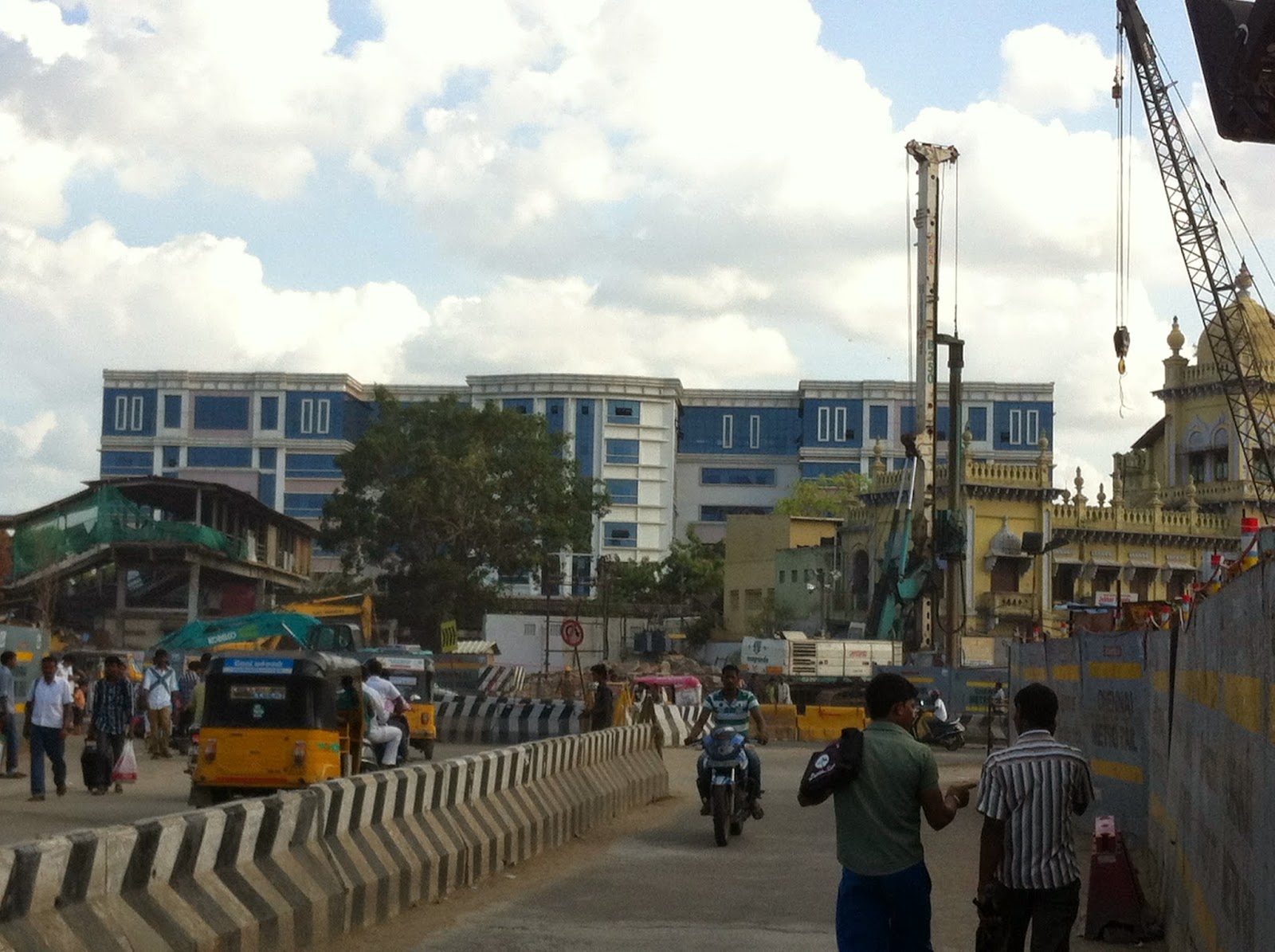
New building

That's the new building of the Madras Medical College. Construction was completed last year and it was then waiting for its classrooms to be furnished. Surely all of that would have been done - I hope it is ready to see students at least in the new academic year coming up.

Do you remember what was here earlier? This!


Monday, June 2, 2014

Headache relief

Desodharaka Kasinadhuni Nageswara Rao Pantulu has made an appearance in this blog earlier, via the park bearing his name. His appearance on earth was a long time ago; he was born in 1867 and after his schooling in Machilipatnam, he moved to Madras for his higher studies. After completing his degree from the Madras Christian College, Nageswara Rao ventured into some kind of business. That was not very successful, because the next few years saw him in Calcutta and then in Bombay, where he was working in some office.

It was in Bombay that Nageswara Rao formulated a balm to relieve headaches. It is said that he worked as an apothecary while in Calcutta; maybe he did and the skill he acquired there helped him to both concoct the balm and to sell it to headache stricken sufferers. He named it after Amrit, the legendary nectar of immortality. Amrutanjan soon became the balm of choice in Bombay, but for some reason that I have not been able to figure out, Nageswara Rao brought the business to Madras. It may have been because of his growing association with the movement to create an Andhra state distinct from the Madras Presidency. Whatever the reason was, the production base of Amrutanjan moved near his home in Mylapore, on Luz Church Road.

The factory has remained there since; one can imagine the whiff of the balm being prepared wafting on the sea breeze down Luz Church Road. That pain balm continues to be the mainstay of Amrutanjan Healthcare Ltd, even though the company has branched off into other products. The gate in the picture leads to the head office of the firm; though the factory is also listed as being at this location, most of the production has moved to a new location outside the city. 

The Wikipedia page has it that Nageswara Rao started off distributing Amrutanjan free at music concerts. If that is true, it doesn't speak well of Bombay's concerts in the late 19th century, does it!


Friday, February 14, 2014

Ayurveda for everyone

That tiled house in the corner of a Triplicane street once belonged to Gopalacharlu, a renowned ayurvedic practitioner. To merely say his name that way is to lessen the man, because his renown was not just due of his personal expertise in ayurveda. Vaidyaratnam Pandit Deevi Gopalacharlu was also reputed to be a great teacher, borne out by the fact that at least two of his students - Dr K.N. Kesari and Bhishagratna Achanta Lakshmipathi - went on to become famous physicians themselves, with the latter succeeding his mentor as the principal of the ayurvedic college, after Gopalacharlu passed away in 1919.

Pandit Gopalacharlu was born in 1872 at Machilipatnam. He studied ayurveda at Mysore and started his practice at the Theosophical Society's Vaidyasala in Bangalore. After a while, he moved his practice to Madras. In 1898, he started the Ayurvedasramam to take ayurvedic medicines to the masses. It was located somewhere in George Town, because a signboard from around that time (now on sale at ebay) advertising the "Indian Nerve Tonic" also provides the location as "Ayurvedasramam, G.T. Madras". 

That tonic, "Jeevamrutham" was one of the best sellers from the Ayurvedasramam. The Wellcome Library of London, one of the richest troves of medical history, also has images (advertisements?) of three other products: Manasollasini, or The Memory Pills, Abalasanjeevani or The Nectar for Female Diseases, Hysteria, etc. and Narayana Thailum or The Gout, Rheumatism and Paralysis Destroyer. The Ayurvedasramam does not seem to be popular these days - Dr. Desikachaarlu, the Vaidyaratnam's great-great-grandson runs his practice at West Mambalam, a fair distance from George Town. The only indicator of the this house's heritage is a board - you can see it if you open the picture in a new tab and look below the gable - plugging Jeevamrutham!


Wednesday, January 22, 2014

Hospital annexe

The Kasturba Gandhi Hospital in Triplicane has been serving the women of Chennai for well over a century. Though the hospital was initially established somewhere in Nungambakkam or Egmore, it moved to its current location at Triplicane very early on and has been functioning from there all this while.

The picture shows the out-patient department, across the road from the main hospital buildings. These must also be the same vintage as the hospital itself, judging by the nature of the building and the materials. The difference is that the OP department is a single storey-ed structure while the main hospital is housed in much taller buildings.

Unlike the namesake railway station, whose name has been effectively converted into a mockery ("Kasturibai") of the original, the hospital is still sticking to the Kasturba spelling, at least in the English signboard. The Tamizh version has gone out tentatively, claiming it to be the Kasturiba hospital!


Thursday, January 2, 2014

Jam your liver

It is one of those buildings that, by having been around for so long, makes you feel guilty asking about the origins of its name or any such thing. Had heard of the Jammi Buildings in Royapettah a very long time ago; if I remember right, it housed some big time office of the TN Civil Supplies Corporation in the late 1970s. Dad talked about having to go there for something to do with the ration card, but it was the name that caught attention. Jummy!

It was much later that I heard about Dr. Jammi Venkataramanayya and his miracle ayurvedic cure for problems of the liver. Jammi's Liver Cure (as it says on the board)  must have been like one of Jeeves' pick-me-ups for Madras' Woosters. Minus the raw egg, of course. But I have not come across anyone who has actually used Jammi's product, which makes me suspect that everyone has been treated with it. Dr. Jammi's early success was to target the product to specifically treat infantile jaundice - and in the early 20th century, when he began his practice, such success would have given him a God-like aura.

The firm that he started continues as Jammi Pharmaceuticals today. Headquartered in the Jammi Buildings itself, they are very modern - you can get in touch with them online or even buy their products as capsules and syrups. Do you think you need one of those after the night-before-last?!


Friday, October 5, 2012

Different system

India has had a rich tradition of medicinal thought and action. Apart from home grown systems of medicine, the land had little problem in allowing new methods to come in and be practiced along side the older ones. Some of them have grown so big as to threaten the continued existence of the so called traditional systems of medicine.

One such system is Unani. The word originally meant 'Greek' and probably referred to Hippocrates. Though based on his principles, the system evolved quite differently from the 'Western' systems and, as far as I know, is making a spirited last stand in India. One of the reasons for its continued survival must surely be the efforts of the Government of India to prop it up, along with a few other systems. Under the Ministry of Health and Family Welfare, there is a department named AYUSH - that's an acronym for Ayurvada, Yoga & Naturopathy, Unani, Siddha and Homeopathy - which funds several research institutes across the country. 

Research in Unani medicine falls under the CCRUM - the Central Council for Research in Unani Medicine. The CCRUM runs over 25 institutions, covering the spectrum of research to drug development. Most of the research is carried out through the seven Regional Research Institutes - of which one is in Chennai. Located on West Mada Church Road in Royapuram, this one seems to taking its research real easy - or maybe it is just that it was a Sunday!


Friday, May 13, 2011

Roots of medicine

A shop in Velachery that sells some exotic things. Things that the city dweller needs because he hasn't yet left the village behind him. Things that assure her that her newborn is getting the best of nature. Things that only a "nattu marundhu kadai" can provide.

No, it does not - and should not - translate as "country medicine shop". That's missing the entire point. Like many other phrases, "naatu marundhu kadai" defies neat translation, because of the need for deeper understanding of tradition and culture. These are not really "country", but more like "non-city"; and "marundhu" here is not really medicine, but the ingredients - seeds, fruits, accessories - that are needed for making some traditional recipes. Recipes that are used for "health tonics"..... well, that's the best way of describing "kashayams", isn't it, although "lehyam" is beyond me for now!


Posted by Picasa

Tuesday, September 15, 2009

Who was it

This building itself has many stories about it, but I shall keep those for another day (with a different picture, I promise!). Today it is about one of the signs in the picture, a name that has been in business in Madras since the 1880s: Allbutt & Co., Pharmacists. Despite the name having survived for so long - I seem to remember the shop being open for business even in the early 1990s - little is known of the Allbutt, the man himself.

That doesn't stop me from speculating, however. Though I did not know it before, a search on Google tells me that Allbutt is a hallowed name in medicine; Sir Thomas Clifford Allbutt who lived between 1836 and 1925, was not only a skilled physician, but also a medical historian and an inventor. He taught at the University of Cambridge, where he was made a Regius professor in 1892. He wrote his classic on medical history, 'Greek Medicine in Rome' quite late in life, in 1921, but his own place in the history of healthcare was assured when he designed the modern clinical thermometer in 1866.

It is another Allbutt who leads the Google search results for 'Allbutt Madras', however. Dr. Henry A.Allbutt was a member of the Malthusian League. In 1879, at a medical conference in Amsterdam, a lecture by three French physicians convinced him that contraception was not medically harmful. Strengthened with this conviction, he persuaded the Malthusian League to set up a group to spread this information among doctors and was also made the Secretary of that group. Apparently, one of the reasons for his strong committment to birth control was his experiences of problems in India; he was invited to be a Patron of the Hindu Malthusian League in Madras in 1882. Possibly, that gave him added information for his sixpenny booklet, published in 1886, named 'The Wife's Handbook', which included a summarised version of the then major contraceptive methods. The General Medical Council in England found this to be "infamous conduct in a professional respect" and his name was struck off the medical register.

It is highly probable - almost certain - that neither physician had any interest in Allbutt & Co., Pharmacists. But I can't help thinking that someone who was impressed by either Allbutt's work borrowed the name for a shop in Madras!


Wednesday, July 22, 2009

Flying doctor

Unlike Dr. Guruswamy Mudaliar, his contemporary, Dr. Sarukkai Rangachari often treated his patients for free. In fact, there are stories about how he gave a poor fisherwoman Rs.100 to take care of herself and her newborn child, and also how he once gave a boy a coin a day when he was down with typhoid. (That boy went on to become a famous neurosurgeon, incidentally). That kind of generosity coupled with 'rare medical skill and boundless humanity' made sure his clinic 'Kingston', on Poonamallee High Road was always full of patients. He would start his day at 4 am, performing varied surgeries until 11 am, followed by the in- and out-patient clinics, after which he would make house calls. Often, his lunch was had in his car, a luxury he defended by saying that he practically lived in the vehicle, and so allowed himself the privilege of making it a nice home.

One of his students, Lt Col Dr C.R. Krishnaswami, recalls that Dr. Rangachari was blessed with a wonderful constitution, that "from 1906, when he started, till his death in 1934, it was continuous, strenuous work of up to 18 hours a day for Dr. S. Rangachari." That constitution could not, however, stand up to the rigours he placed upon it during the typhoid breakout of 1934. Fighting hard against the sweep of the epidemic, Dr. Rangachari pushed himself to even longer hours, reaching out to more patients than anyone else thought possible. And so, when the disease struck the doctor, he succumbed to it, passing away at the height of his powers and popularity. The public of Madras subscribed to a statue in honour of this surgeon, which was unveiled by Lord Erskine, Governor of Madras, in 1939. That statue still stands near the exit gate of the General Hospital, shaded by a cupola, a couple of hundred meters away from that of Dr. Guruswamy Mudaliar.

There was another significant difference between the two contemporaries; where Dr. Guruswamy was frugal, Dr. Rangachari was outwardly lavish - apart from using a Rolls Royce to travel within the city, he had his own private aircraft (in the early 1920s) to make house calls in cities other than Madras!


Tuesday, April 7, 2009

The good doctor

It was 1957 and the 'Asian Flu' had begun to spread out from China, where it had originated. Memories of the Spanish Flu of 1918 were quite fresh; when a second wave of the Asian Flu began in 1958, it caused general panic in the regions it struck. Madras was not immune to it and hundreds in the city fell ill and the doctors had a field day, trying out all kinds of concoctions on suffering patients. Each of them had his own presciption, in all probably mixed up by a loyal 'compounder', jealously guarded and claiming greater efficacy than that of competitors. It is not surprising that all these doctors raised a hue and cry when, in an interview to a popular weekly, Dr. Guruswamy Mudaliar suggested that the tablet 'Elkosin' was probably the best cure for the raging 'flu. They claimed that Dr. Guruswamy had violated medical ethics by naming a specific brand.

Their alarm was well-founded. Dr. Guruswamy had made his reputation by keeping his mouth shut, listening to his patients, relying on 'percussion diagnosis' even where it was not traditionally used. Though well off, he was modest and frugal; and yet, Dr. Guruswamy would never treat anyone, no matter how poor, without a fee, because he was convinced that if anything was free, it was without value. His brilliance in medicine meant that he could not be denied a full professorship at the Madras Medical College - and so he became the first Indian to hold the post of Professor of Medicine, in the early 1920s. This was the man who had been interviewed during the 'flu epidemic and had voiced his opinion on the mode of treatment. According to him, the service of humanity overruled the ethics of the profession in this situation.

Dr Guruswamy died that same year, 78 years old and still capable of rattling the 'modern' doctors of his time. When a bridge was built near where he lived in Kilpauk, there was only name that could be given to it - a name that it continues to bear today!


Friday, October 3, 2008

Seeing is believing

It is rather ironical that if you come here on account of the raison d'être of this institution, you may not be inclined to gaze upon its wonderful heritage buildings. However, you can take consolation in the fact that, given its record, this institution will enable you to do so when you leave its grounds after completing your course of treatment. That's kind of reflected in the motto of the Regional Institute of Ophthalmology and Government Ophthalmic Hospital: "To make the unseen - seen".

While Chennai is justifiably proud of its modern eyecare facilities, the RIOGOH can take especial pride in being the fount of them all. When it was established in 1819, the Madras Eye Infirmary was the second specialized ophthalmic hospital in the world, the first being Moorfields in London, which was opened in 1805. The Madras Eye Infirmary grew, and after being housed out of a couple of temporary facilities moved into these buildings on Marshalls Road in 1884. The first time I went in there was in 1981, when a friend had an accident that badly damaged his eye and the next time was a couple of weeks ago, to take some photographs for the blog.

On my first visit, I was too young - and in too much of a panic mode - to appreciate the heritage of this insititution. I will be back here very soon, for the Elliot's Museum of Ophthalmology seems to be something worth visiting!


Friday, April 25, 2008

A system of medicine

This shop (is that really what it is?) sign on TTK Road has intrigued me since I first noticed it about 4 years ago. It indicates a completely new theory of diagnosis and cure, one that is based on study of the wallet rather than of the anatomy. Haven't seen crowds milling around it, waiting to be cured of their ailments for Rs.5 a pop, so maybe there is something deeper to the "5 Rs Health" after all.