Showing posts with label government. Show all posts

Thursday, January 26, 2017

Republic day

Sixty-seven years ago, it was on this day that India formally declared itself to be a republic, with the constitution that had been adopted exactly two months before coming into force. The choice of this date is significant; between 1930, when the Indian National Congress 'officially' promulgated India's independence and 1947, when the country was actually granted independence (and Dominion status), January 26 was celebrated as Purna Swaraj Divas. With the Constitution of India coming into effect in 1950, the monarch of Britain ceased to be the Head of State and that power transferred to the President of IndiaThat structure is replicated in each state of the Union of India. Part VI of the Constitution deals with the States, with Article 153 creating the position of Governor and Article 154 invests in him the executive power of the State, with a Council of Ministers to "aid and advise" the Governor. The position is something of an anomaly in that the people of the state have little say in who their Governor should be; a person is appointed to hold that post at the pleasure of the President of India. 

Tamil Nadu has been without a full-time Governor since August 31, 2016; the Governor of Maharashtra holds this position as an additional charge. It is not the first time this has happened, but on both the earlier occasions, it was the Governor of Andhra Pradesh who also played the role of Tamil Nadu's Governor. The first such was when Krishan Kant took charge for 55 days and the next was C. Rangarajan, who had a longer stint of six-and-a-half months. On neither occasion, however, did Tamil Nadu have to deviate from the practice of the Governor taking the salute at the State's Republic Day parade - it came very close to that in 1997, but Krishan Kant handed over charge to Fatima Beevi on January 25, ensuring that protocol was intact. This year has been the first time in Tamil Nadu that the Chief Minister takes the salute. 

What does all this have to do with the picture for the day? Not much, really. Except that I had seen two former Governors of West Bengal at The Hindu's LitForLife a few days ago; that got me thinking about why there has been such tardiness at finding a Governor for Tamil Nadu. Not that I have any answers for it, of course!


Tuesday, December 16, 2014

Four-in-one

In the annexe to the Art Gallery at Chennai, there are a few paintings of the British Governors of Madras. They are not arranged in any particular order and there are four of them put together in one corner of the first floor. 

Here they are, from left to right: Field Marshal George Hay, 8th Marquess of Tweeddale (1842-48), Lord Harris (1854-59), Francis Napier, 10th Lord Napier and 1st Baron Ettrick (1866-72) and Robert Bourke, 1st Baron Connemara (1886-90). 

What happened to those who held office in between these gentlemen's regimes? Some of them have their paintings hung at the Fort Museum - and there are probably others whose tenures were eminently forgettable - maybe their paintings have been turned away to face the wall somewhere! 


Thursday, December 11, 2014

Stopped in its tracks

In the 19th century, many of the companies operating in India were incorporated in London. It was therefore quite easy for Messers Hutchinson & Co to set up a firm in London to offer services to the people of Madras. Hutchinson's idea was to run electric trams, since there seemed to be a high level of acceptance for horse-drawn trams in the city. And so, in 1892, the Madras Tramways Company was floated on the London Stock Exchange with a capital of £100,000. It took them three years to build the first section of the tramway and it was on May 7, 1895 that the first electric tram started running in the city. But that was the formal launch, for the trams had been making sorties in the pervious weeks, and the public was encouraged to hop on for free rides. In the week before the formal inauguration, pamphlets were distributed, reminding them that they would have to pay for rides at the rate of 6 pies a mile. 

That was not very profitable for the company, and in 1900, M/s Hutchinson sold Madras Tramways Company to The Electric Construction Company (also based in England). Maybe they were also unable to run it well, for we find that in 1904, a new company has been formed to take over the tramways of Madras. That was The Madras Electric Tramways Limited - and they seemed to have either found the secret to profitability or very deep pockets, for they went on an spree of extending the tramlines; 1905, 1911 and 1919 saw new lines being added, and the company was running trams over 16-plus miles, 11 of them double-tracked. But eventually, after the II World War, the company had intractable labour disputes, which went on and on, eventually forcing them to wind up operations on April 11, 1953. They hoped to re-commence, but in the late 1950s, most of the tram-tracks in the city were removed and the trams have never since run in the city. 

With the company owning 110 tramcars at its peak, they needed sheds to be parked in. The main such tramshed was on Poonamallee High Road, at what today is Periyar Thidal, near the office of the Dina Thanthi. The other major shed was on Radhakrishnan Salai, and you can see the shed in this picture. It is today part of the TANGEDCO's facilities. The only city in India where trams continue to run (at least, I think they still do) is Kolkata. But the trams of Calcutta started only in 1902 - seven years after the service in Madras. And that is one of the lesser known 'firsts' that the city of Chennai holds - the first tram services anywhere in India!


Tuesday, October 21, 2014

Special medicine

Another view of the super-multi-speciality hospital - the building which was originally supposed to be the new home of the Tamil Nadu state assembly. 

Would have expected to see more crowds. Is it because people don't get sick enough to go to hospital on a Sunday morning? 


Friday, October 10, 2014

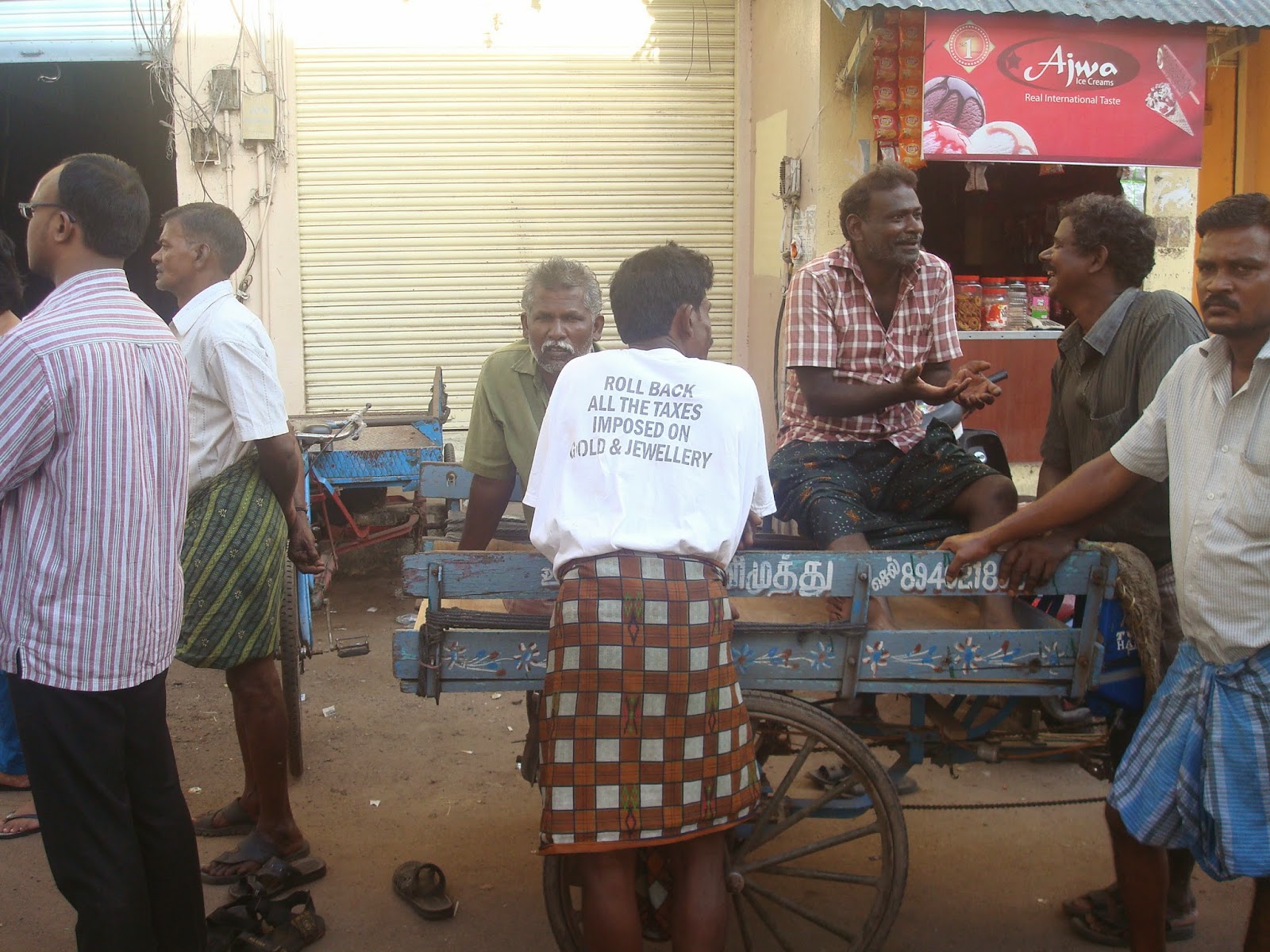
Demand

He is suffering because of the government's misplaced taxation policies. Why doesn't his government listen to him?

And yes, I agree with him!


Thursday, October 9, 2014

The view north

The Marina Beach is supposedly 13 kilometres long, but that's the entire stretch from the edge of the Port of Chennai, all the way down past Besant Nagar. Somehow, I am unable to consider all of that as one beach, because the shoreline changes its character as it passes through Chennai.

This 4km stretch is most likely the beach that captivated Sir Mountstuart Elphinstone Grant Duff when he visited Madras sometime in the 1870s. He returned to Madras in 1881, this time as its Governor. One of the first things he did was to commence building a promenade along the sandy strip. On its being opened to the public in 1884, he named it the "Marina", from his recollection of the Sicilian beach - apparently an Italian general, when walking along the promenade with the Governor, mentioned to him that the beach reminded him of Palermo.

Since then, the Marina has been graced - and at times disgraced - by several projects. It was one of the key points in the city for public and political rallies. Thilagar Thidal, where Mahatma Gandhi addressed the people on his visits to Madras, is now just a memory. At the northern end, memorials to two former state Chief Ministers got the courts to declare that the beach should not be used for any other such memorials. At the moment, the sandy strip is going through one of its relatively cleaner phases; so, even if you are not able to go along all the 13km, this stretch should be good enough to rejuvenate you!


Thursday, September 11, 2014

King governor

Part of the interest in this foundation stone is the organization itself. The Triplicane Urban Cooperative Society (TUCS) has been around for such a long time that their head office building considers itself to be in "New Buildings", even though those buildings were opened in 1952. 

The buildings took a little less than three years to come up. The foundation stone, dated 8th December 1949 is interesting for another reason. It was laid by the last monarch of the Gohil dynasty, which ruled Bhavnagar - and it precursor Sekjakpur - since the 12th century CE. 

Though the foundation stone credits his royal title, it was not in that capacity that he was present on this occasion. Though he was the last of his dynasty, Maharaja Raol Shri Krishna Kumarsinhji Bhavsinhji Sahib Gohil, KCSI, had a first to his credit. He was the first Indian Governor of Madras (his predecessor Lt Gen Sir Archibald Edward Nye was the last British governor) - and it was in that capacity that he was here!


Wednesday, August 6, 2014

Square arch

This was raised in 2012 to commemorate the 60th anniversary of the Tamil Nadu legislature. It was earlier the Madras state and somehow it was felt necessary to mark the transition of the name of the state with this structure. 

It is called an arch, but its outline defies the definition. 

For better or worse, it is going to remain on the Kamaraj Salai for a while, so let us enjoy it while it is around!


Wednesday, June 18, 2014

Lease of life

The media have been all agog over a heart transplant operation performed in this hospital a couple of days ago. While the coordination between the hospitals involved and the Chennai City Traffic Police was indeed commendable, not much attention has yet been given to the framework that enabled it to come about. In the 20 years since the Transplantation of Human Organs (THO) Act, 1994 was passed, Tamil Nadu has led the country by many a mile in reaping the benefits of this Act. In 2012, over 40% of the donors (and the harvested organs) were from Tamil Nadu, giving it a donation rate of 1.15/million population (Punjab with 0.43 and Kerala with 0.36 were the nearest)

Chennai, of course, has been in the vanguard of this movement. In 1999, five hospitals in the city came together to create the Indian Network for Organ Sharing, under the MOHAN Foundation. The experience with this project was encouraging and the state government came into it in 2008, setting a clear process to support such sharing - the Cadaver Transplant Programme, which has become the point of reference for other states to implement similar programmes. 

Fortis Malar, pictured here, was where the transplant was carried out on Monday evening. But there are other hospitals, both private and government-run, that have carried out similar procedures as a matter of routine. The newsworthiness of Monday's transplant was the traffic management, to ensure that the heart was moved here from the donor hospital in double-quick time. But let us also take a moment to cheer the progress achieved in making such transplants routine!


Tuesday, March 11, 2014

Watching factories

There was a time when one was expected to know how many Inspectors of Factories there were in the state, apart from their bosses, the Deputy Chiefs, on to Joint Chiefs, and thence to the Chief himself.  Considering that the Chief wielded the power to dictate how a factory should be run, he (it has always been he, I don't think Tamil Nadu ever had a woman chief so far) was a shoo-in to have his office in what was once a palace.

The Khalsa Mahal is the southern block of the Chepauk Palace, which was the residence of the Nawabs of Arcot. It was built in 1768 and was acquired by the government in 1850. It is likely that the initial designs were drawn up by Paul Benfield, but in the 1870s, they were expanded by Robert Chisholm. Khalsa Mahal survived quite intact through those efforts, but in recent years, the building has been sorely threatened by fires, and parts have actually been consumed by flames, as well.

The Chief Inspector of Factories may have shifted out of here by now. In fact, there is no more a position called Chief Inspector of Factories. The nomenclature has changed and it is now called Director of Industrial Health and Safety - and the (currently) 48 Inspectors have had their titles changed as Deputy Directors. Wonder if the factories are running ship-shape now!


Sunday, February 23, 2014

Multipurpose building

It was intended to be the integrated complex housing the state's legislative assembly, the secretariat and maybe some government department offices as well. But with petty rivalries overtaking any kind of reasonable thinking, the entire building has been 're-purposed' to be inaugurated as a multi-super-speciality hospital.

As somebody mentioned, the architect must have been a super-duper thinker. It doesn't matter what you want to use it for, the building will be able to accommodate it!


Saturday, February 22, 2014

First in co-operation

Frederick Nicholson, Collector of Madras in the late 19th century, had proposed setting up agricultural credit banks to alleviate the problems faced by the farmers. That experiment was successful, and a few years later, the government was attempting to see how that model could be extended to non-agricultural sectors as well. Both these attempts - the agricultural credit banks as well as the extension of such credit facilities to other sectors - were spearheaded by the Madras Presidency, but their impact was across the subcontinent. 

Based on the recommendations of the committee that considered extension of credit societies, The Co-operative Credit Societies Act 1904 was passed in March 1904. Almost as soon as the Act was passed, a group of people in Triplicane registered the first society under that Act. The Triplicane Urban Co-operative Society (TUCS) thus became India's first registered co-operative body. The founders included V.R. Singaravelar and Ambat Sivarama Menon, with VS Srinivasa Sastri taking charge as the first President. 

TUCS continues to be extremely active today. It is run by a Special Officer deputed by the state government, and has over 100,000 individual members. It also has close to 300 institutional members - not including the state government, which is the largest shareholder - and over 50 other co-operative societies as members. Its turnover during the current financial year is expected to cross Rs.200 crores, making it a very decently run organization. The building in the picture is the headquarters of TUCS, inaugurated in 1952. Being the first in the country, TUCS has had a huge role in shaping the progress of the co-operative movement across India - even if that is hidden from many of the citizens!


Saturday, January 11, 2014

Old hall

Edward, the second Lord Clive, during his time as the Governor of Madras, wanted to commemorate the Company's victory over Tipu Sultan. His wish culminated in this building, in 1802. John Goldingham, more famous as the astronomer of Madras, was the one who designed this magnificent structure. 

Does it remind you of the Parthenon at Athens? That was apparently the effect that Goldingham was aiming for. The original flight of steps leading up were much narrower, but flanked by sphinxes. These broader steps have added to the grandeur of this building, which was originally called the Banqueting Hall. Apart from the grand banquets hosted by the governor, this hall was also used by the University of Madras in its early years for its convocations. Much later, in the late 1930s, this was the seat of the Madras Presidency's legislature. 

After India's independence, this was renamed to honour the first Indian Governor-General, C. Rajagopalachari. Rajaji Hall became a warren of government offices and a spot for filming movie sequences. At least it was in the public eye then, but now, with most of the surrounding buildings of similar vintage having been demolished, Rajaji Hall sits rather uncared for!


Sunday, August 25, 2013

The first SEZ

India can take credit for a lot of firsts on the global stage and Chennai can do likewise on the national stage (and in some cases, globally as well). That's why many consider Chennai (Madras) to be the first city of modern India. And, as the place where it all began, Fort St George can take pride in all the firsts that have been listed.

There is however one 'first' that has not been considered. And that's what my wife told me last evening. "Do you realize" said she, "that Fort St George is the first SEZ in the country?". That's true. When it was set up, 374 years ago, the fort was exempt from paying any taxes on its revenues. It was also allowed duty-free imports, so by practical standards, this factory on the Coromandel coast could indeed have been India's first Special Economic Zone!


Wednesday, November 14, 2012

Side gate

By the 1970s, the only college on College Road was the Women's Christian College. So it was natural for me to assume that the road was named after that institution. However, the road was named so much before 1915, which was when the WCC was founded. Even a century before that, this area housed the College of Fort St George. That was started in 1812, with the singular purpose of teaching the Fort's clerks the languages of south India. 

That college was important enough for the Governor of Madras to visit it regularly. Although it sounds rather improbable today, His Excellency could choose to reach the college either by road, or, in a more leisurely fashion, by boat. Yes, the Cooum (to the right of this picture) runs by the college. A clear, silver stream, with the shade of the trees on its banks - who would not like to cruise on such a river! 

To receive the Governor, any old gate would not do. And so this arched entry for the Governor's carriage. It certainly adds a touch of class to this part of the road even today, despite some uninspired restoration effort. Only that there is no more a college that is inside these premises - this gateway takes you to the Directorate of Public Instruction and the offices of the Tamil Nadu Textbook Society. Not really the stuff for a governor to pay attention to. And with the median blocking a direct entrance through the arch, one would have to be satisfied with ducking in by a quick turn into the gate!


Wednesday, October 24, 2012

Throwing some light

Of course you know all about Chennai's lighthouses. But I did not realize until quite recently that the lighthouse on the Marina is still called the Madras Lighthouse, making it one of the few institutions that have not - and hopefully never will - changed over to the Chennai nomenclature. 

It is not just this lighthouse. The stretch of lighthouses along the peninsula, from Kovilthottam in the Kollam district of Kerala on the west coast to the one at Pulicat just north of Chennai falls under the jurisdiction of what is called the Madras District. Says who, you ask? It is the Directorate General of Lighthouses and Lightships, that's who. The Madras District is one of the four that are headed by a Deputy Director General; the others being Jamnagar, Kolkata and Headquarters. 

Kolkata district has had its name changed from the former Calcutta. So too has Bombay, changed to Mumbai. But then, neither of them has a lighthouse named after the city - and that should make Madras stay on for a long while!


Tuesday, March 23, 2010

Assemble here!

If you were in Chennai last Saturday - the 13th - you could not have missed the inauguration of the new Legislative Assembly and Secretariat building complex. After 53 years, the Tamil Nadu Legislative Assembly met again within the Government - now named the Omandurar - Estate, having spent those years meeting at Fort St George.

It is the first Legislative Assembly in the country to be awarded the LEED-Gold Certification; that's not the highest level of 'Green-ness' for buildings. But it missed (or rather, opted to not go for) the LEED-Platinum certification for 2 reasons: using an air-cooled system for CO2 monitoring, which consumes more energy than a water-cooled system and having bright facade lights, keeping in mind security and aesthetic concerns.

But even then they can switch off the lights in the daytime can't they!


Monday, January 4, 2010

Three-card trick

Through most of the '70s, even well into the '80s, it was not uncommon to find cows and buffalos being led from street to street by the local milkman. Milk was fresh, straight from the udders and you could feel the warmth spread through the vessel as the milkman poured out your requirement. It was a leap, not merely of faith, but of several degrees of temperature, when Aavin began regular supply of milk through the city sometime in the '70s. Chilled bottles with candy-stripe tinfoil caps would be delivered at a milk booth, twice a day; folks from the neighbouring streets would have to come to the booth and pick-up their quota. Once you made a decision on how much milk you needed every day and how you wanted it split between the morning and the afternoon deliveries, you had to live with that decision for the rest of your life - or that is how it seemed to be.

Milk bottles gave way to half- and one-litre sachets; more choices came by. Toned, double-toned and low-fat varieties were added. More automatic vending machines sprung up. The gathering of housewives and servants at the milk booth of an afternoon gave way to aggregators picking up volumes on behalf of their customers; the new age milkmen, supplying sachets at your door, for a fee. With the state loosening its monopoly on milk in the late '90s, private dairies increased the choices available. Through it all, Aavin's milk-card remained a prize; with a discount of close to 15% being given to a card-holder, it made sense to buy a card. In the past, being allowed to buy one was the result of reams of documents and several 'inspections' and 'verifications'. You had to trade off the guarantee of supply (which the milkman was naturally very bad at) against the flexibility of your need (which Aavin seemed to consider an act of treason). And then the deal was "no card, no milk". But with Aavin simplifying the procedures significantly, the 15% discount looks very inviting. Even after the milkman's fee, you have something left over.

The dates for buying / renewing milk cards vary from locality to locality. Yesterday was our turn; our milkman came up and told us that there were new cards available at our booth, all we had to do was go there with proof of residence and we'd get our cards. And so, here I am, three years after having moved into my current flat, with the first set of my milk-cards!


Friday, July 17, 2009

Official craft

I am not sure if this was originally intended to house a government institution, or if that institution moved in there later. Whichever the order, this building, housing the headquarters of 'Poompuhar' - the brand name of the Tamilnadu Handicrafts Development Corporation Ltd - seems quite different from others of similar vintage along Mount Road.

Where most of the others - think Higginbothams, the State Bank of India building, the Gove Building, P.Orr and Sons - seem to show off their architectural splendour, the Poompuhar building seems to revel in its straight, box like lines. Despite all that, it is easy to make out this building is also one that has seen a lot of history go down the Mount Road!


Tuesday, June 2, 2009

White, black and red

No matter how many sleek cars come out, the Ambassador seems to have a completely impregnable niche as the car of choice for all officialdom in the country. Though Hindustan Motors has a manufacturing facility in Chennai, the Ambassador is built at their plant in Uttarpara, West Bengal. The first ever car to be mass-manufactured in India, the Ambassador was originally based on the Morris Oxford, but has had a few changes (that's right, just a few) in its design since the first Ambassador rolled out in 1948.

I am sure in much of the country's hinterland, the white Ambassador continues to be an enduring symbol of the government; and even within that, there would be categories, I guess - white Ambassador with pitch-dark windows would indicate a senior official, while one that includes a red beacon would probably be the pinnacle of babu-dom. On the streets of Chennai though, this is just another car, trying to use the extra fittings to get past the traffic faster!