Showing posts with label Fort St George. Show all posts

Monday, January 23, 2017

Room for worship

When the British - Andrew Cogan and Francis Day - set up the 'factory' on the site where Fort St George stands today, catechisms and prayer books were very far from their thoughts. The Portuguese merchants, further south near Mylapore, already had their San Thome. When some of those merchants moved to the new settlement, they needed a place for their worship. The British allowed them to build their own church, St Andrew's, which has disappeared over the decades. 

Later, the British built their own church, St. Mary's, which continues to be in use today as the 'oldest Anglican church east of the Suez'. There are records of a Church Street, which is supposed to run from just outside St. Mary's to the fort's southern glacis. Maybe that was the road taken by the residents in the fort - the merchants and their families - to access the church. 

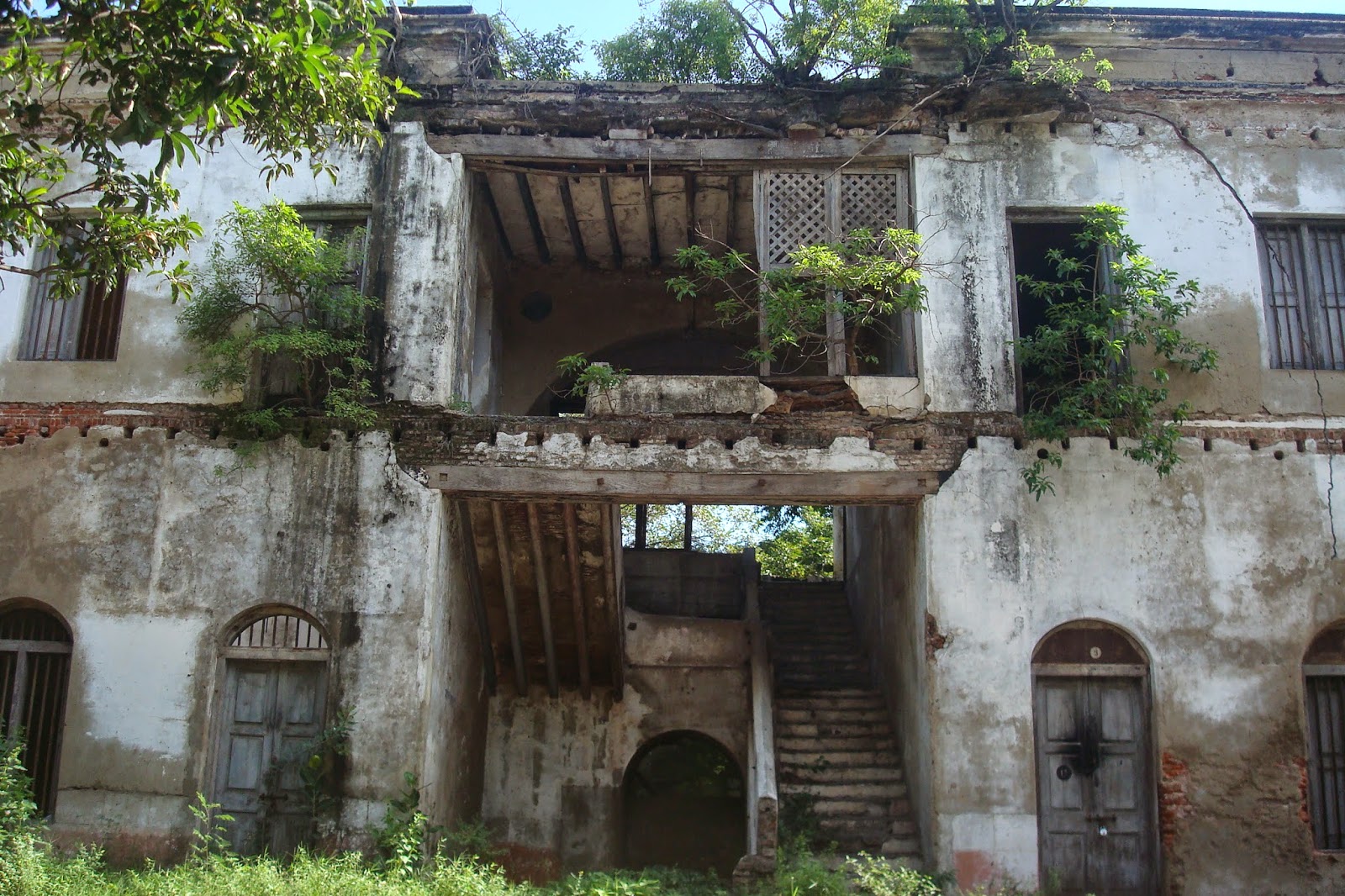
Most of the buildings on Church Street are in disrepair today. But among the ones that still stand, is this one with a sign over the door saying "St Marys Church Room"!


Tuesday, April 5, 2016

Posh place

The city of Madras, as we know, was initially just the space enclosed within the walls of Fort St George. As in any city, there were some parts which were more favoured as residential areas than others. The most favoured portion in the Fort was its south-eastern quarter. It was the furthest point from the Customs House, and so presumably far enough away for the smells of goods to not bother the residents; plus where the sea-breeze would blow through unhindered. 

The two streets in that quarter, running north-south, parallel to each other, are St Thomas Street and Church Street. Church Street is the more eastern of the two and therefore having less of a cachet. St Thomas Street was the favoured residential area, and the nine residences there - four on the eastern side and five along the western flank. These were built sometime in the early years of the 18th century. If you were a resident here, your neighbours would have been Majors, Colonels and members of the Council - and the chaplain of St Mary's Church.

Most of those houses are gone, fallen to ruin. Others are well on their way there. The ASI is gamely trying to do something about preserving these structures. This one - a large building that has its front door on St Thomas Street and its rear verandah on Church Street - would have been used both as a residence as well as a temporary storehouse for bales of cloth or barrels of wine as they were being traded into and out of the country. But today, it is barely able to stand up, a ghostly reminder of the glory that was once the "Snob's Alley" of Madras!


Wednesday, December 17, 2014

Groves

I have known of Palmgrove the hotel, and also of Palm Grove, the army officers' quarters in Fort St George. But I did not know that the army's golf course is also referred to as the Palm Grove Golf Course.

Nor did I know that the army was maintaining an ecological park with the same name nearby!


Monday, September 29, 2014

Library - the first

Situated within the complex of buildings under the Department of Public Instruction, this building houses what is arguably the first 'lending library' in the country. It was not originally intended to be a library. Started as the Madras Literary Society in 1812, its objective was to be forum - a learned forum to present papers and discuss advances in science, geology, archeology, anthropology and sociology, and then to be a repository for these papers and related collections. 

Those papers and collections went on to be the seeds for starting several other institutions such as the University of Madras, the Connemara Library and even the state government's Archeological Department. Even so, it still retains about 80,000 books, which are lent out to the Society's ~200 members. The books are mostly door-delivered; keeping in sync with the institution, most of the members are senior citizens, who are grateful for this service. The library, however, does not lend its older books. Even though the members - at different points, the roster of members included Annie Besant, Dr. S. Radhakrishnan and Subas Chandra Bose - are very careful about handling the books, the library is careful to circulate only newer books: meaning, ones that were printed after 1950.

It is worth a visit to take a look at some of the older volumes. The oldest is probably a 1619 copy of Aristotle's Opera Omnia. There are of course several stacks of other reference material, going back to the early and middle 20th century. Of course it is a wonderful place for historic research in any of the subjects it specialized in. But if you are a true bibliophile, you must consider volunteering time to help the Society sort and categorize its collections. Otherwise, we might end up continuing to see 'Pride and Prejudice' displayed in the New Arrivals section!


Sunday, September 21, 2014

Old damage

This is one of the buildings inside the Fort St George complex. At some point, it would have served as the barracks for the troops stationed inside the Fort. Maybe it was also housing for some of the administrative staff in the Fort - remember, most of the big names of Anglo-Indian history began their careers as 'writers' with the East India Company. Did they stay in these kind of lodgings?

The damage to these has been caused by neglect and nature, rather than any planned hand. But on this day in 1746, after a couple of weeks of aggression, the French forces under Bertrand-François Mahé, Comte de La Bourdonnais, entered the city of Madras - basically Fort St George - having called upon the English to give up all their possessions and suffer themselves to be prisoners of war.

The French occupation lasted for just a couple of years. These buildings came up much after the 1746-49 occupation of Fort St George by the French. But if things continue to go the way they are right now, the demolition of the Fort will be completed by sheer inaction!


Tuesday, September 16, 2014

Nearer river

A city needs rivers to survive and to thrive, and today's Chennai has the Adyar, the Cooum, the Otteri nullah and the Buckingham Canal. The last named is a man-made creation, but more of that elsewhere. In 1639, when Francis Day and his boss Andrew Cogan were negotiating with the Nayak of Poonamallee for a lease-hold on the beach, they used the Cooum as the southern boundary of the area they wanted. On the east, the Bay of Bengal limited their territory. The northern end was not so well defined - there probably was an existing settlement which couldn't be encroached upon. To the west, there was a river, one that is not often remembered today.

The River Elambore was closer to the 'factory' established by the British East India Company. But over the years, it has lost its identity and, in the early 19th century, it became a part of the Buckingham Canal - and in today's maps, it is described as a loop of the Cooum rather than a river by itself.

This picture was taken along the Flagstaff Road, and it shows the river flowing in from the west, forming the northern border of the Island Grounds.


Sunday, August 10, 2014

Second bridge

In the earliest days of the city of Madras - essentially the Fort St George - the main exit from the city would probably have been through the Walajah gate, heading out west to the seat of the Nayaks at  Poonamallee. There would have been less reason to go south; the twin rivers in that direction would have made it even less attractive. But by the early 18th century, the journey to the Mount was a reason for the residents of the Fort to cross two rivers. Bridges were required. The Elambore River was probably the easier to ford; there is a record from 1714 about a "Water-Gate Bridge" between the Fort and the Island. The second bridge, over the Cooum took another two years to be built.

Called the Triplicane Bridge, it appears to have been a rather ill-fated bridge. In 1721, it was damaged by floods. Though it was repaired, repeated floods brought it down. As if nature wasn't enough, la Bourdonnais also brought it down. Between man and nature, the bridge kept falling down and rising up, until the new century came up. In 1805, a new bridge was built. The earlier one(s) never had any formal name(s) - Triplicane Bridge and Island Bridge were variously used, with startling originality. 

The same originality continued into the new century, with the new bridge. Or maybe it was just superstition or sentimentality, for the bridge was named after the patron saint of England. Not just that. It was called the New St George's Bridge, for, in the intervening period, the Water-Gate Bridge had been replaced by St George's Bridge about fifty years earlier. That name continued to be in use for well over a hundred and fifty years. It was only in the late 70s that it was renamed after EVK Ramasamy Naicker, and it is by his name that it continues to be known today - Periyar Bridge!


Tuesday, August 5, 2014

Remembrance

It has been a hundred years since the Great War began. Being a part of the British Empire at the time, India was drawn into the war, without too much of a say in the matter. Notionally a volunteer force, the Indian Army was pitched into several battles; with them were the armies of several princely states and European volunteers. The total number of troops from India was over a million. Almost four-fifths of them were sent to Middle East Asia, with the rest going to France and to Africa. 

Over 60,000 soldiers from India lost their lives in the Great War. The founding nucleus of the Indian Army, the Madras Regiment, had its fair share of causalities. The city decided to honour the fallen with a memorial at the south-west end of Fort St George. The space that was known as "Cupid's Bow" until then was cleared up and an open, circular stone pavilion was built. On the western side, the circle is marked with the years 1914 and 1918.

This pillar, in the centre of the circle, was a later addition, after World War II. The years are repeated here. Around the circle, each section commemorates a battlefield where soldiers from Madras Presidency laid down their lives. Some of the names are no longer in common use: Mesopotamia, for example. Some others:  well, they have become so enmeshed with fighting that one reads them with weariness - for example, Gaza. This memorial to the fallen soldiers of the Madras Presidency has been modified to reflect some of independent India's wars. Let us hope that there will not be reasons to keep updating this memorial!


Thursday, March 13, 2014

Green hospital

No, it is not a comment on their environmental credentials, but merely about the colour scheme of this building. Situated inside Fort St George, this serves as the Ex Military Hospital as well as the Section Hospital. The building was probably not built to serve as a hospital (does that remind of you of another such?), but has been taken over to serve as one. 

The first hospital in Fort St George was set up in 1664, thanks to two gentlemen (they must have been Company doctors) William Gyford and Jeremy Sambrooke petitioning the governor Sir Edward Winter, saying, "...we have thought it very Convenient that they might have an house on purpose for them, and people appointed to looke after them and to see that nothing comes in to them, neither of meate nor drinke, but what the Doctor alloweth", the 'they' referring to English soldiers coming to Fort St George. Sir Edward agreed with them, and the hospital was established on November 16, 1664. 

That hospital appears to have moved around inside the fort for a while, sometimes being commandeered for use as barracks, before being ordered out of the fort, into Peddanaickanpet, in 1752. That hospital grew into something else. Much later, after independence, the Indian Army took over parts of Fort St George. And they went ahead and took over this building for its current purpose. Wonder if the ex-servicemen coming here would heed the exhortation of "neither meate nor drinke"!


Saturday, March 1, 2014

People on the Street

The first of the month is 'Theme Day', over at the City Daily Photo group and the theme for today is the title of this post. Found it a bit difficult to get a decent picture to reflect the theme. Sounds crazy that in a city of 4.7 million people (2011 census data; The Economist's factbook puts it at 11m), it should be easy to get people into the frame without even trying. But a majority of my pictures have no people in them.

So here is one. And if you click through the picture, you'll see that the red sign reads "York Street". Don't bother looking through your Chennai maps for this one, because York Street, along with St Thomas Street, Middle Gate Street, Charles Street, Choultry Street, Gloucester Street, James Street and Church Street were the names given to the paths between the buildings inside Fort St George. 

In the middle of the 17th century, when it was set up, the Fort was the city for the British. And they did need to identify the means of access to places within the Fort. What better way to do it than to name the streets (mainly) after places back home!


Theme Day features several CDP bloggers from around the world interpreting the theme in their own cities in their own ways. Click here to see some of those!

Friday, February 7, 2014

Bridge-builder?

Every school student knows, or should know, that the Muslim League shadowed the Congress during the pre-Independence days, and during the Provincial Assembly elections of 1946 won a quarter of the seats, making it the second largest national party. With Independence and the partition of India, the Muslim League was also splintered. In December 1947, a meeting of the League in Karachi, it was agreed that those members who had opted to stay back in India would constitute the Indian Union Muslim League

Many such members were from south India and therefore it was natural that the first meeting of the IUML would be held in Madras. That was on March 10, 1948 at the Rajaji Hall (then known as Banqueting Hall). The meeting elected Muhammad Ismail, who had been the Leader of the Opposition in the Provincial Assembly of Madras, as the first President of the IUML. Ismail also served on the Constituent Assembly, and in the Rajya Sabha, as a representative of the Madras State. In 1956, after the states were reorganized, Ismail moved to Kerala and won three elections to the Lok Sabha from Manjeri. 

There are two colleges in his honour in Chennai itself. The bridge that gets people out of Fort St George and onto Mount Road reminds us of him. Appropriate, considering that Muhammad Ismail sought to connect different sections of people in his days of public service, both as a politician and as a member of various industry and advisory bodies. Despite all these visible reminders, not many remember Muhammad Ismail today. The colleges, and this bridge are all named after his title, "Quaid-e-Millat"! 


Monday, January 20, 2014

Not just the soul

You might remember that, in Chennai, the patron saint of drivers is the 'Bodyguard' Muniswaran. That appellation came about because of where the Muniswaran's shrine is located, but many drivers are firm in their belief that it is because of the special powers of this deity to protect the bodies - their own as well as that of their vehicle's. 

Further up Mount Road, a little after Pallavan Salai, is this board that is truer to the origins of the Bodyguard title. The Governor's Bodyguard was raised in 1778 and unlike many other units of the army, retained that title until it was disbanded. Though it started off as a Europeans-only unit, later expansion meant that it had to include the natives, of which there was a fair number of Musalmans. The unit had its barracks to the south of Fort St George, across the road from where Madras Gymkhana is today. The Europeans had their places of worship within the fort, but the troops had to make their own arrangements for worship. It appears that sometime towards the end of the 19th century, a mud-and-thatch structure was being used as a mosque; in 1904, with some public subscriptions, a more permanent structure was raised, and a full-fledged mosque began functioning there, with the Mullah being provided a room within the sepoy lines. 

The Governor's Bodyguard was disbanded in 1947. Some of the space that the troops were using was retained with the army, and most of the rest was handed over to the state Transport Department. The land where the temples and the mosque were located were of course handed over to the trusts that continue to administer them to this day. And yes, the sign points to the minaret of the mosque itself!


Tuesday, September 24, 2013

Hogwarts?

Makes your head spin, does it? Looking up at these stairs inside Clive House, you do get a tinge of vertigo. The stairs are to one side of the great hall on the first floor of the building and take you to different levels, up, down and sideways. 

The Great Hall inside Clive House is not much to look at, for it is just that - a big hall. It is when you think about the debates and the arguments that may have taken place there that you realize its significance in shaping the dominion of India. Though originally owned by Shawmier Sultan, an Armenian merchant, the Admiralty House was taken over by the East India Company in 1755. The Great Hall was used not only for meetings but also for banquets and balls. During one of the wars, when St Mary's Church served as a granary, the Great Hall was used for conducting services.

Most of the rooms leading off, and adjacent to the Hall are locked up today. You can troop up and down these stairs, but the only door that you can pass through is the one below that lets you out of the building!


Saturday, August 31, 2013

History house

You can be forgiven for passing by this crumbling ruin even without a first look. It is certainly not an advertisement for the attractions of Fort St George; even though it is listed as a protected monument, it has certainly been left unprotected for a very long time. 

Once upon a time, this was the residence of Arthur Wellesley, 1st Duke of Wellington. This is the same Wellesley who went on to be a hero at the battle of Waterloo, but for all that, he does not seem to have had made much of an impression on the good people of Madras. 

Unlike its neighbour, Clive House, the Wellesley house is just marking time until it comes down completely. So, if you want to see (what is left of) it, head out to the Fort right now! 


Sunday, August 25, 2013

The first SEZ

India can take credit for a lot of firsts on the global stage and Chennai can do likewise on the national stage (and in some cases, globally as well). That's why many consider Chennai (Madras) to be the first city of modern India. And, as the place where it all began, Fort St George can take pride in all the firsts that have been listed.

There is however one 'first' that has not been considered. And that's what my wife told me last evening. "Do you realize" said she, "that Fort St George is the first SEZ in the country?". That's true. When it was set up, 374 years ago, the fort was exempt from paying any taxes on its revenues. It was also allowed duty-free imports, so by practical standards, this factory on the Coromandel coast could indeed have been India's first Special Economic Zone!


Thursday, October 25, 2012

Old view

Have you ever wondered about what Madras would have looked like in the middle of the eighteenth century? If so, all you have to do to satisfy your curiosity is to walk along to the Fort Museum. Apart from all those statues - that of Cornwallis being the most in-your-face - there are quite a few paintings showing various facets of the fort. 

This one seemed especially nice; the ships coming in from the sea appear to be firing their cannons. But the fort itself seems quite unperturbed by this aggression. Notice the gate of the fort. It opens out almost into the sea itself; at high tide, the sea was right there at the gate - even now that eastern gate is also referred to as the Sea Gate. 

Maybe everyone in the fort knew that the 'Madras Roads' would not allow the ships to get close enough to inflict any serious damage!
  

Friday, September 21, 2012

Bank by the wayside

The Chennai office of the Reserve Bank of India has the Fort Glacis as its address. But it spurns the security of the fort's walls, preferring to sit just outside. Of course it was a much later creation than the fort; by the time the RBI was set up in 1935, the fort had for long been an administrative centre rather than a trading outpost. 

The building is quite impressive, if you can stop to look at it. The massive door has RBI's logo on it and even the latticework besides the door repeats the design. Most of the time, however, folks just whiz by - and because of the subway, even that view is fairly limited.

Just wondering - is there an underground passage from the bank into the fort?


Monday, January 2, 2012

Forgotten pedestal

Few people know why Cenotaph Road is called so; fewer still would have had the patience to figure out where the components of the cenotaph are located today. 

The original cupola, housing the statue of the 1st Marquess Cornwallis, remains untraceable. It's last shelter is now outside, on the grounds of the Fort St George, while the statue itself frowns imperiously on the visitors entering the Fort Museum. The base of the statue has this description of why it was erected. Maybe it is still not in tune with the wishes of Chennai's citizens, but Cenotaph Road has been spared the spate of renaming that the city's roads have been subjected to... and has remained the same for over 211 years, now!


Saturday, May 28, 2011

General well-being

The Government General Hospital at Chennai is one of the oldest institutions in the city - and quite likely the oldest functioning hospital in the country. It started off as a small hospital to treat the soldiers of the British East India Company who were routinely falling prey to various tropical maladies. It was Sir Edward Winter, during his first stint as the Agent of Fort St. George, who inaugurated this hospital on November 16, 1664.

It wasn't much of a hospital, initially. being based out of one of the houses in the Fort. And for a few years, it moved around inside the Fort itself, before the general congestion of the Fort and the 'Town' area forced it to look outside. It was only in 1762 that a new site was identified, a little away from the Fort, on the road to Poonamallee. 

None of the buildings from that time was preserved when these new buildings came up in the early 2000s. All the old buildings were taken down and these two blocks replaced them. Supposedly, a couple of plaques from those buildings are preserved somewhere inside this campus - but discovering them may be more difficult than the task Charles Donovan faced in discovering the kala-azar agent in 1903. Even the plaque commemorating that discovery, one of the high points of the hospital's history is also missing!


Tuesday, May 24, 2011

Precious coral

For almost a hundred years, from 1688 to 1786, Anglo-Dutch Jews moved to Madras and played a major role in the trade of precious stones. Strange as it may seem, the 'natives' were fascinated by coral and were willing to trade even diamonds for it. The Jewish traders typically had an arrangement where one brother was a free merchant near Fort St George, another was based in London and a third in Amsterdam. That helped: coral from the Mediterranean, which was much sought after by the people of India, was shipped to Fort St George through London. (In return, the merchants of Leghorn, Naples and other cities on the Mediterranean seem to have been paid in pepper). Diamonds obtained as payment for this coral were sent to Amsterdam for cutting and polishing.

It appears that the Jews played a significant role in moving the centre of the coral trade from Goa (then with the Portugese) to Madras, which would explain their pre-eminence in this trade in the early days of the city. However, with the discovery of diamonds in other parts of the world, their value fell and the trade became less lucrative. Also, there appears to have been a shake-up in 1765 with the bust of a diamond smuggling ring, in which 3 Jewish agents from Madras (and the governor of Madras) were alleged to have been involved. 

The trade was then taken over by the Nagarathars. Whether they continued to trade coral or not, they took up offices in the street vacated by the Jewish traders. By this time, the street was itself so closely associated with the coral trade that it was called Pavazhakkarar Theru - Coral Merchants' Street. It is likely that anyone commencing trading activities there would be dubbed a Pavazhakkarar, whether coral was part of his bill of materials or not. And in keeping with the fascination for red coral, this gift from 'Coral Naiker Madras' to the city's Corporation, has been topped off with bright red paint!


The book "Diamonds and Coral: Anglo-Dutch Jews and Eighteenth-Century Trade", by Gedalia Yogev seems to have some fascinating accounts of the Jews of Madras, going by excerpts found here!